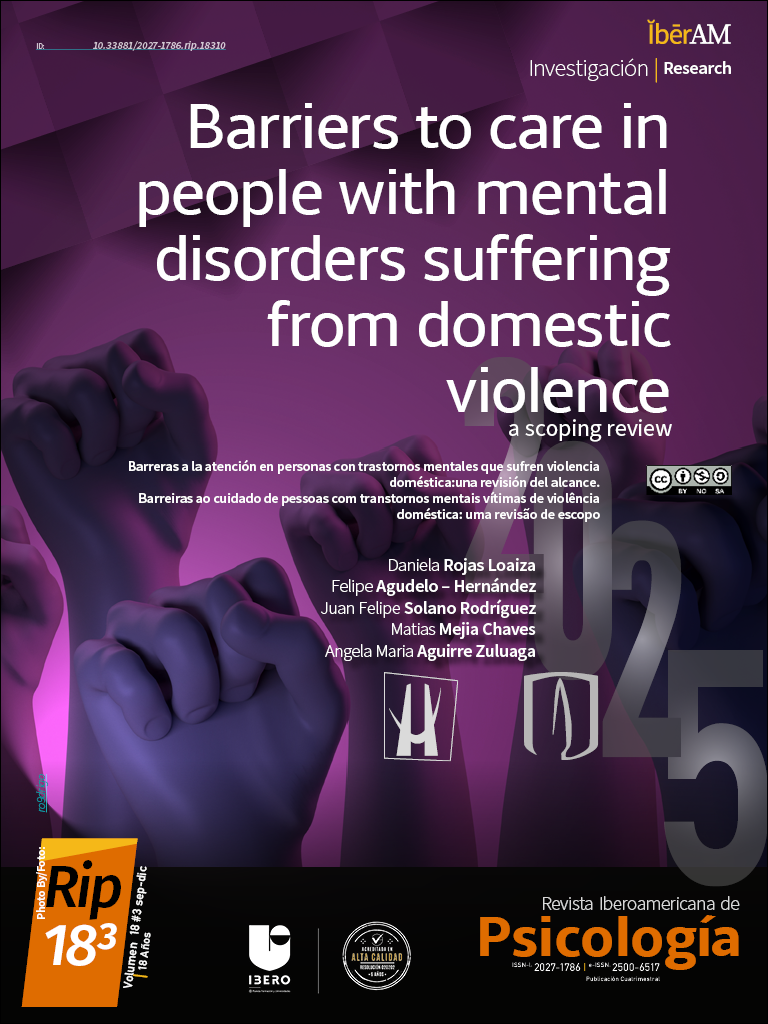
Barriers to care for domestic violence in people with mental disorders: a scoping review
Barriers to care for domestic violence in people with mental disorders: a scoping review [Domestic violence in mental disorders]
Barra lateral del artículo
 PDF
PDF
 FLIP
FLIP

Los autores que publican en la Revista Iberoamericana de Psicología están de acuerdo con los siguientes términos:
- El Autor o los autores, desde que presenta(n) a consideración de esta revista su manuscrito, esta(n) informado(s) acerca de la política de Acceso Abierto, como condición indisociable de publicación, lo que significa que ni él(los), ni la revista han de percibir ingreso alguno por concepto de la lectura de resúmenes o del artículo completo, tampoco por su uso o explotación para generar nuevo conocimiento o para desarrollar aprendizajes alrededor de la obra.
- Los autores conservan los derechos de autor y garantizan a la revista el derecho de ser la primera publicación del trabajo, al igual que licenciado bajo una Creative Commons Atribución-NoComercial-CompartirIgual 4.0 Internacionalque permite que permite a terceros utilizar lo publicado, siempre que se haga mención a la autoría del trabajo y la primera publicación en esta revista, no se utilice con fines comerciales y que las obras que se deriven del artículo se compartan en iguales condiciones.
- Los conceptos y opiniones expresados en los artículos son responsabilidad exclusiva de los autores y no comprometen a la Revista Iberoamericana de Psicología ni a la Corporación Universitaria Iberoamericana. Los contenidos de esta revista se distribuyen bajo licencia de tipo Creative Commons Atribución 4.0 Internacional, la cual exige el debido reconocimiento de las obras y cuyos términos se encuentran en: https://creativecommons.org/licenses/by/4.0/deed.es
- La Revista Iberoamericana de Psicología es una revista de acceso abierto, por lo que tanto el proceso editorial como los contenidos publicados están disponibles para todos los usuarios sin cargo alguno: la Revista no realiza cobro alguno por acceso, lectura o descarga de contenidos ni por procesos o actividades de la editorial con fines de publicación.
Citaciones



Contenido principal del artículo
Se ha descrito que los indicadores de violencia doméstica son mayores en personas con trastornos mentales y esto podría aumentar todavía más las barreras de acceso a la salud. El objetivo del presente estudio fue identificar estas barreras en personas con trastornos mentales que sufren violencia doméstica. La búsqueda se llevó en 2023, y usó como código las siguientes palabras clave ((Mental Disorders OR Persons with Mental Disabilities) AND (Sex Offenses OR Gender-Based Violence OR Domestic Violence)) AND (Barriers to Access of Health Services). De los 71 artículos incluidos de bases de datos y tres de literatura gris, 43 referenciaron barreras de Acceso a los Servicios de Salud en personas con trastornos mentales. Estas barreras son diversas y están influenciadas por factores individuales, sociales y del sistema de salud. El estigma, la falta de educación, la dependencia económica y emocional hacia el agresor, la pobreza y la actitud negativa del personal de salud son algunas de las principales barreras identificadas. Es evidente la necesidad de abordar estas barreras para garantizar que las personas con trastornos mentales que han sido víctimas de violencia reciban la atención médica adecuada.







Descargas
Detalles del artículo
*Agudelo, S. F. (n.d.). Aproximación narrativa a las intervenciones en salud para mujeres y niñas supervivientes de violencia sexual en la Red Suroccidental de Bogotá, 2003-2004. http://www.scielo.org.co/scielo.php?script=sci_arttext&pid=S0034-74502007000300002
*Alvarez, C., & Fedock, G. (2018). Addressing Intimate Partner Violence With Latina Women: A Call for Research. Trauma, violence & abuse, 19(4), 488–493. https://doi.org/10.1177/1524838016669508
*Alhusen, J. L., Bloom, T., Anderson, J., & Hughes, R. B. (2020). Intimate partner violence, reproductive coercion, and unintended pregnancy in women with disabilities. Disability and health journal, 13(2), 100849. https://doi.org/10.1016/j.dhjo.2019.100849
*Anderson, G. D., & Overby, R. (2020). Barriers in seeking support: Perspectives of service providers who are survivors of sexual violence. Journal of community psychology, 48(5), 1564–1582. https://doi.org/10.1002/jcop.22348
*Anderson, S. (2011). A way through the woods: opening pathways to mental health care for women with multiple needs. Advances in Dual Diagnosis, 4;2. https://doi.org/10.1108/17570971111162993
Begun, R. W., & Huml, F. J. (2006). Prevencion de la Violencia: Anticipacion y Resolucion de los Conflictos Violentos en la Escuela. Troquel Editorial.
*Brenisin, K., Akinwande, E., Trumm, A. & Breen, K. (2021). The impact of inequality on mental illness: thematic analysis on clinical notes. The Journal of Forensic Practice, 23; 4: 360-371. https://doi.org/10.1108/JFP-06-2021-0037
Bennett Cattaneo, L., DeLoveh, H.L.L & Zweig, J. (2008). Sexual Assault within Intimate Partner Violence: Impact on Helpseeking in a National Sample. Journal of Prevention & Intervention in the Community, 36:1-2, 137-153, DOI: 10.1080/10852350802022415
Campbell J. C. (2002). Health consequences of intimate partner violence. Lancet (London, England), 359(9314), 1331–1336. https://doi.org/10.1016/S0140-6736(02)08336-8
Dawson, A. J., Rossiter, C., Doab, A., Romero, B., Fitzpatrick, L., & Fry, M. (2019). The Emergency Department Response to Women Experiencing Intimate Partner Violence: Insights From Interviews With Clinicians in Australia. Academic emergency medicine : official journal of the Society for Academic Emergency Medicine, 26(9), 1052–1062. https://doi.org/10.1111/acem.13721
DeCou, C. R., Lynch, S. M., Weber, S., Richner, D., Mozafari, A., Huggins, H., & Perschon, B. (2023). On the Association Between Trauma-Related Shame and Symptoms of Psychopathology: A Meta-Analysis. Trauma, violence & abuse, 24(3), 1193–1201. https://doi.org/10.1177/15248380211053617
*Freedberg P. (2006). Health care barriers and same-sex intimate partner violence: a review of the literature. Journal of forensic nursing, 2(1), 15–41. https://doi.org/10.1111/j.1939-3938.2006.tb00049.x
Ghafournia, N., & Healey, S. J. R. (2022). Identifying domestic violence and sexual assault presentations at a regional Australian hospital emergency department: Comparative analysis of domestic violence and sexual assault cases.
Women's health (London, England), 18, 17455057221103992. https://doi.org/10.1177/17455057221103992
Ghasemi, E., Majdzadeh, R., Rajabi, F., Vedadhir, A., Negarandeh, R., Jamshidi, E., Takian, A., & Faraji, Z. (2021). "Applying Intersectionality in designing and implementing health interventions: a scoping review". BMC public health, 21(1), 1407. https://doi.org/10.1186/s12889-021-11449-6
Ghoshal R. (2020). Twin public health emergencies: Covid-19 and domestic violence. Indian journal of medical ethics, -(-), 1–5. Advance online publication. https://doi.org/10.20529/IJME.2020.056
*Gilmore, A. K., Leone, R. M., Hahn, C. K., Oesterle, D. W., & Davidson, T. M. (2021). Barriers to Accessing Mental Health Care After a Sexual Assault Medical Forensic Examination. Journal of forensic nursing, 17(2), 84–92. https://doi.org/10.1097/JFN.0000000000000321
*Henderson, C., Evans-Lacko, S., & Thornicroft, G. (2013). Mental illness stigma, help seeking, and public health programs. American journal of public health, 103(5), 777–780. https://doi.org/10.2105/AJPH.2012.301056
*Herz S. E. (1999). Violence against people with disabilities: barriers to diagnosis, prevention, and treatment. Academic medicine : journal of the Association of American Medical Colleges, 74(10), 1058–1060. https://doi.org/10.1097/00001888-199910000-00004
*Hickson, L., Khemka, I., Golden, H., & Chatzistyli, A. (2013). Views and Values of Developmental Disabilities and Domestic Violence/Sexual Assault Support Professionals Regarding the Prevention and Handling of Situations of Abuse. Journal of Policy and Practice in Intellectual Disabilities, 10(3), 207–214. https://doi.org/10.1111/jppi.12040
Keilty, J., & Connelly, G. (2001). Making a statement: An exploratory study of barriers facing women with an intellectual disability when making a statement about sexual assault to police. Disability & Society, 16(2), 273-291.
*Kisa, R., Baingana, F., Kajungu, R. et al. Pathways and access to mental health care services by persons living with severe mental disorders and epilepsy in Uganda, Liberia and Nepal: a qualitative study. BMC Psychiatry 16, 305 (2016). https://doi.org/10.1186/s12888-016-1008-1
*Loring, M. T., & Smith, R. W. (1994). Health care barriers and interventions for battered women. Public health reports (Washington, D.C. : 1974), 109(3), 328–338.
*Lucea, M. B., Stockman, J. K., Mana-Ay, M., Bertrand, D., Callwood, G. B., Coverston, C. R., Campbell, D. M., & Campbell, J. C. (2013). Factors Influencing Resource Use by African American and African Caribbean Women Disclosing Intimate Partner Violence. Journal of Interpersonal Violence, 28(8), 1617–1641. https://doi.org/10.1177/0886260512468326
*Mantler, T., Jackson, K. T., & Walsh, E. J. (2020). Integration of Primary Health-Care Services in Women's Shelters: A Scoping Review. Trauma, violence & abuse, 21(3), 610–623. https://doi.org/10.1177/1524838018781105
*McGilloway, C., Smith, D., & Galvin, R. (2020). Barriers faced by adults with intellectual disabilities who experience sexual assault: A systematic review and meta-synthesis. Journal of applied research in intellectual disabilities, JARID, 33(1), 51–66. https://doi.org/10.1111/jar.12445
*Monteiro, S., & Brigeiro, M. (2019). Experiences of transgender women/transvestites with access to health services: progress, limits, and tensions. Experiências de acesso de mulheres trans/travestis aos serviços de saúde: avanços, limites e tensões. Cadernos de saude publica, 35(4), e00111318. https://doi.org/10.1590/0102-311X00111318
*Nichols, E, Bonomi, A, Kammes, R. & Miller, E. (2018). Service seeking experiences of college-aged sexual and intimate partner violence victims with a mental health and/or behavioral disability. Journal of American College Health, 66:6, 487-495, DOI: 10.1080/07448481.2018.1440572
*O'Hara, J. (2008). Why should I care about gender? Advances in Mental Health and Learning Disabilities, 2;2:9-18. https://doi.org/10.1108/17530180200800012
*Olsen, A. & Carter, C. (2016). Responding to the needs of people with learning disabilities who have been raped: co-production in action. Tizard Learning Disability Review, 21;1: 30-38. https://doi.org/10.1108/TLDR-04-2015-0017
*Østergaard, M. L. D., Aponte-Canencio, D. M., Barajas Ortiz, Y., Velez Botero, H. J., Simon Modvig, J., & Brasholt, M. (2023). Vulnerability factors in conflict-related mental health. Medicine, conflict, and survival, 39(1), 63–80. https://doi.org/10.1080/13623699.2022.2156232
*Overstreet, N.M. & Quinn, D.M. (2013). The Intimate Partner Violence Stigmatization Model and Barriers to Help Seeking. Basic and Applied Social Psychology, 35:1, 109-122, DOI: 10.1080/01973533.2012.746599
Panamerican Health Organization – PAHO. (2022).Entendiendo y actuando contra el estigma en salud mental en contextos de salud. Campusvirtualsp.org. https://www.campusvirtualsp.org/es/curso/entendiendo-y-actuando-contra-el-estigma-en-salud-mental-en-contextos-de-salud-2022
*Petersen, R., Moracco, K. E., Goldstein, K. M., & Clark, K. A. (2004). Moving beyond disclosure: women's perspectives on barriers and motivators to seeking assistance for intimate partner violence. Women & health, 40(3), 63–76. https://doi.org/10.1300/j013v40n03_05
*Robinson, L., & Spilsbury, K. (2008). Systematic review of the perceptions and experiences of accessing health services by adult victims of domestic violence. Health & social care in the community, 16(1), 16–30. https://doi.org/10.1111/j.1365-2524.2007.00721.x
*Rodríguez, M., Valentine, J. M., Son, J. B., & Muhammad, M. (2009). Intimate partner violence and barriers to mental health care for ethnically diverse populations of women. Trauma, violence & abuse, 10(4), 358–374. https://doi.org/10.1177/1524838009339756
*Rojas-Bernal, L. Á., Castaño-Pérez, G. A., & Restrepo-Bernal, D. P. (2018). Salud mental en Colombia. Un análisis crítico. Ces Medicina, 32(2), 129-140.
*Rozo-Gutiérrez, N., Durán, E., Román-Ochoa, M. A., Pabón, A. C. B., Niño, M. B., & Martínez-Durán, M. (2022). Programa de atención psicosocial y salud integral a víctimas del conflicto armado, Algeciras (Huila), Colombia, 2018. Revista De La Universidad Industrial De Santander. Salud, 54(1). https://doi.org/10.18273/saluduis.54.e:22020
*Scriver, S., Mears, E. & Wallace, I. (2013). Older women and sexual violence: recognising and supporting survivors. The Journal of Adult Protection, 15; 6:301-316. https://doi.org/10.1108/JAP-03-2013-0008
*Silva, T., Agampodi, T., Evans, M., Knipe, D., Rathnayake, A., & Rajapakse, T. (2022). Barriers to help-seeking from healthcare professionals amongst women who experience domestic violence - a qualitative study in Sri Lanka. BMC public health, 22(1), 721. https://doi.org/10.1186/s12889-022-13116-w
*Sin, C., Mguni, N., Cook, C., Comber, N. & Hedges, A. (2010). Targeted violence, harassment and abuse against people with learning disabilities in Great Britain. Tizard Learning Disability Review, 15;1:17-27. https://doi.org/10.5042/tldr.2010.0026
Wacker, J., Macy, R., Barger, E., & Parish, S. (2009). Sexual assault prevention for women with intellectual disabilities: a critical review of the evidence. Intellectual and developmental disabilities, 47(4), 249–262. https://doi.org/10.1352/1934-9556-47.4.249
World Health Organization. (2021). Suicide. https://www.who.int/data/gho/publications/world-health-statistics
World Health Organization. (2018). Violence Against Women Prevalence Estimates, 2018: global and regional prevalence estimates for intimate partner violence against women and global and regional prevalence estimated for non-partner sexual violence against women. Geneva: World Health Organization.
World Health Organization. (2022). World mental health report: transforming mental health for all. https://www.who.int/teams/mental-health-and-substance-use/world-mental-health-report
*White Hughto, J.M., Clark, K.A., Altice, F.L., Reisner, S.L., Kershaw, T.S. & Pachankis, J.E. (2018). Creating, reinforcing, and resisting the gender binary: a qualitative study of transgender women’s healthcare experiences in sex-segregated jails and prisons. International Journal of Prisoner Health, 14;2: 69-88. https://doi.org/10.1108/IJPH-02-2017-0011
*Zibin, T., Mitib Altakhaineh, A.R. & Zibin, A. (2022). A critical assessment of the structural dimensions of gender-based violence. The Journal of Adult Protection, 24; 5/6: 243-254. https://doi.org/10.1108/JAP-04-2022-0007