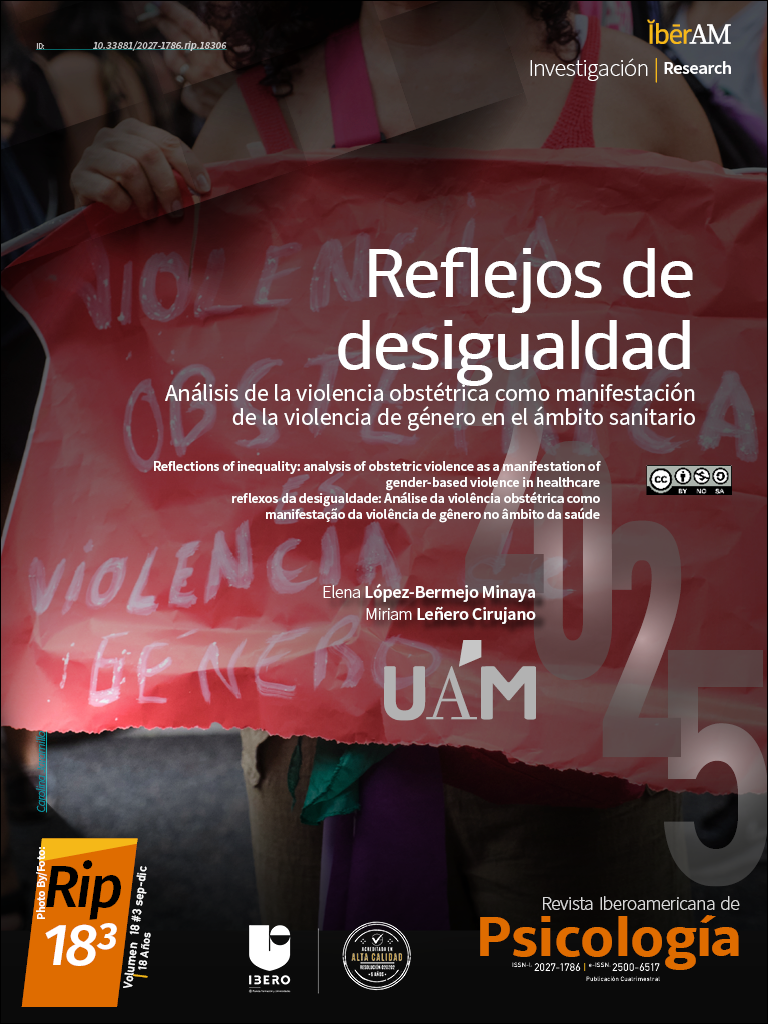
Reflections Of Inequality: Reflections Of Inequality [Analysis Of Obstetric Violence As A Manifestation Of Gender-Based Violence In Healthcare
Reflejos de desigualdad: análisis de la violencia obstétrica como manifestación de la violencia de género en el ámbito sanitario
Article Sidebar
 PDF (Español (España))
 FLIP
FLIP

Los autores que publican en la Revista Iberoamericana de Psicología están de acuerdo con los siguientes términos:
- El Autor o los autores, desde que presenta(n) a consideración de esta revista su manuscrito, esta(n) informado(s) acerca de la política de Acceso Abierto, como condición indisociable de publicación, lo que significa que ni él(los), ni la revista han de percibir ingreso alguno por concepto de la lectura de resúmenes o del artículo completo, tampoco por su uso o explotación para generar nuevo conocimiento o para desarrollar aprendizajes alrededor de la obra.
- Los autores conservan los derechos de autor y garantizan a la revista el derecho de ser la primera publicación del trabajo, al igual que licenciado bajo una Creative Commons Atribución-NoComercial-CompartirIgual 4.0 Internacionalque permite que permite a terceros utilizar lo publicado, siempre que se haga mención a la autoría del trabajo y la primera publicación en esta revista, no se utilice con fines comerciales y que las obras que se deriven del artículo se compartan en iguales condiciones.
- Los conceptos y opiniones expresados en los artículos son responsabilidad exclusiva de los autores y no comprometen a la Revista Iberoamericana de Psicología ni a la Corporación Universitaria Iberoamericana. Los contenidos de esta revista se distribuyen bajo licencia de tipo Creative Commons Atribución 4.0 Internacional, la cual exige el debido reconocimiento de las obras y cuyos términos se encuentran en: https://creativecommons.org/licenses/by/4.0/deed.es
- La Revista Iberoamericana de Psicología es una revista de acceso abierto, por lo que tanto el proceso editorial como los contenidos publicados están disponibles para todos los usuarios sin cargo alguno: la Revista no realiza cobro alguno por acceso, lectura o descarga de contenidos ni por procesos o actividades de la editorial con fines de publicación.
Citations



Main Article Content

Institutional and social power dynamics can perpetuate forms of violence against women, particularly in the realm of sexual and reproductive health. This reflective article aims to explore the interrelationship between gender-based violence and obstetric violence, analyze their implications, and propose evidence-based approaches and professional training for addressing these issues. The results highlight that obstetric violence is a specific manifestation of gender-based violence, reinforcing inequalities and negatively impacting women's physical and emotional health. Invasive and dehumanizing practices that violate women's sexual and reproductive rights are observed. The study concludes by emphasizing the need for evidence-based approaches and professional training to eradicate these practices. It recommends the implementation of gender-sensitive educational programs, clear institutional policies on informed consent and respect for women's autonomy, and the active participation of women in policy development. The study advocates for a strong legislative and academic commitment to promote respectful and equitable healthcare, contributing to academic debate and the development of future research and public policies aimed at gender equity and justice in healthcare.
Downloads
Article Details
Agrawal, I., Mehendale, A. M., & Malhotra, R. (2022). Risk Factors of Postpartum Depression. Cureus, 14(10), e30898. https://doi.org/10.7759/cureus.30898
Al Adib Mendiri, M., Ibáñez Bernáldez, M., Casado Blanco, M., & Santos
Redondo, P. (2017). La violencia obstétrica: un fenómeno vinculado a la violación de los derechos elementales de la mujer. Medicina Legal de Costa Rica, 34(1), 104-111. http://www.scielo.sa.cr/scielo.php?script=sci_arttext&pid=S1409-00152017000100104&lng=en&tlng=es.
Álvarez Terán, R. (2019). El género y la enfermería. Estado de la cuestión. RqR Enfermería comunitaria (Revista de SEAPA) 7 (3), 18-27. https://enfispo.es/servlet/articulo?codigo=7071441
Baum, F., Musolino, C., Gesesew, H. A., & Popay, J. (2021). New Perspective on Why Women Live Longer Than Men: An Exploration of Power, Gender, Social Determinants, and Capitals. International Journal of Environmental Research and Public Health, 18(2), 661. https://doi.org/10.3390/ijerph18020661Agrawal,
I., Mehendale, A. M., & Malhotra, R. (2022). Risk Factors of Postpartum Depression. Cureus, 14(10), e30898. https://doi.org/10.7759/cureus.30898
Bertakis, K. D. (2009). The influence of gender on the doctor-patient interaction. Patient education and counseling, 76(3), 356–360. https://doi.org/10.1016/j.pec.2009.07.022
Bingham, J., Kalu, F. A., & Healy, M. (2023). The impact on midwives and their practice after caring for women who have a traumatic childbirth: A systematic review. Birth, 50(4), 711–734. https://doi.org/10.1111/birt.12759
Bohren, M. A., Mehrtash, H., Fawole, B., Maung, T. M., Balde, M. D., Maya, E., Thwin, S. S., Aderoba, A. K., Vogel, J. P., Irinyenikan, T. A., Adeyanju, A. O., Mon, N. O., Adu-Bonsaffoh, K., Landoulsi, S., Guure, C., Adanu, R., Diallo, B. A., Gülmezoglu, A. M., Soumah, A. M., Sall, A. O., Tunçalp, Ö. (2019). How women are treated during facility-based childbirth in four countries: a cross-sectional study with labour observations and community-based surveys. The Lancet, 394(10210), 1750–1763. https://doi.org/10.1016/S0140-6736(19)31992-0
Busquets Gallego, M. (2019). La violencia obstétrica en el embarazo y el parto desde la perspectiva de la vulneración de derechos: autonomía y consentimiento informado. Cuestiones de Género: de la igualdad y la diferencia, (14), 241–251. https://doi.org/10.18002/cg.v0i14.5803
Chisholm, C. A., Bullock, L., & Ferguson, J. E. (2017). Intimate partner violence and pregnancy: epidemiology and impact. American journal of obstetrics and gynecology, 217(2), 141–144. https://doi.org/10.1016/j.ajog.2017.05.042
Coates, R., Ayers, S., & de Visser, R. (2014). Women’s experiences of postnatal distress: a qualitative study. BMC Pregnancy Childbirth, 14, 359. https://doi.org/10.1186/1471-2393-14-359
Connell, R. (2013). Género, salud y teoría: Conceptualizando el tema en perspectiva mundial y local. Nómadas (Col), 39, 63-77. https://www.redalyc.org/articulo.oa?id=105129195005
Diniz, S. G., Salgado, H. O., Andrezzo, H. F. A., Carvalho, P. G. C. de, Carvalho, P. C. A., Aguiar, C. de A., & Niy, D. Y. (2015). Abuse and disrespect in childbirth care as a public health issue in Brazil: origins, definitions, impacts on maternal health, and proposals for its prevention. Journal of Human Growth and Development, 25(3), 377-384. https://doi.org/10.7322/jhgd.106080
Ehrenreich, B. (2010). Por tu propio bien: 150 años de consejos expertos a mujeres 150 años de consejos expertos a las mujeres. Capitán Swing Libros.
Elmir, R., Pangas, J., Dahlen, H., & Schmied, V. (2017). A meta-ethnographic synthesis of midwives' and nurses' experiences of adverse labour and birth events. Journal of clinical nursing, 26(23-24), 4184–4200. https://doi.org/10.1111/jocn.13965
Instituto Nacional de Estadística. (2020). Encuesta Europea de Salud en España. INE-MSCBS. https://www.ine.es/jaxi/Tabla.htm?path=/t00/mujeres_hombres/tablas_1/l0/&file=d05002.px&L=0
European Commission, Directorate-General for Justice and Consumers, Franklin, P., Bambra, C., & Albani, V. (2021). Gender equality and health in the EU. Publications Office of the European Union. https://data.europa.eu/doi/10.2838/991480
Fernández Gutiérrez, R., Fernández Álvarez, N., Morán Suárez, M., Solís García, P., Fontanil, Y., & Alcedo, M. A. (2024). Violencia hacia mujeres con discapacidad | Violence against women with disabilities. Revista Española De Discapacidad, 12(1), 7-52. https://www.cedid.es/redis/index.php/redis/article/view/975
Freedman, L. P., & Kruk, M. E. (2014). Disrespect and abuse of women in childbirth: challenging the global quality and accountability agendas. The Lancet, 384(9948), e42–e44. https://doi.org/10.1016/S0140-6736(14)60859-X
Goberna-Tricas, J. (2019). Violencia obstétrica: aproximación al concepto y debate en relación a la terminología empleada. MUSAS, 4, (2), 26-36. https://doi.org/10.1344/musas2019.vol4.num2.2
Harding, S. (1995). Feminismo y ciencia. Morata.
Hernández, E., & Rangel-Flores, Y. (2023). Una mirada desde la interseccionalidad a la violencia obstétrica en mujeres indígenas. Confines de relaciones internacionales y ciencia política, 19(37), 31-48.https://doi.org/10.46530/cf.vi37/cnfns.n37.p31-48
Jardim, D. M. B., & Modena, C. M. (2018). Obstetric violence in the daily routine of care and its characteristics. Rev Lat Am Enfermagem, 26, e3069. doi:10.1590/1518-8345.2450.3069
Khalil, M., Carasso, K. B., & Kabakian-Khasholian, T. (2022). Exposing Obstetric Violence in the Eastern Mediterranean Region: A Review of Women's Narratives of Disrespect and Abuse in Childbirth. Frontiers in global women's health, 3, 850796. https://doi.org/10.3389/fgwh.2022.850796
Leite, T. H., Marques, E. S., Mesenburg, M. A., Freitas da Silveira, M., & Leal, M. D. C. (2023). The effect of obstetric violence during childbirth on breastfeeding: findings from a perinatal cohort "Birth in Brazil". Lancet regional health - Americas, 19, 100438. https://doi.org/10.1016/j.lana.2023.100438
Ley 17/2020, de 22 de diciembre, de modificación de la Ley 5/2008, del derecho de las mujeres a erradicar la violencia machista. Boletín Oficial del Estado, 11, de 13 de enero de 2021. https://www.boe.es/buscar/doc.php?id=BOE-A-2021-464
Lozano, M. (2006). La maternidad en escena: Mujeres, reproducción y representación cultural. Prensas Universitarias de Zaragoza.
Lutgendorf, M. A. (2019). Intimate Partner Violence and Women's Health. Obstetrics and gynecology, 134(3), 470–480. https://doi.org/10.1097/AOG.0000000000003326
Martínez-Galiano, J. M., Martinez-Vazquez, S., Rodríguez-Almagro, J., & Hernández-Martinez, A. (2021). The magnitude of the problem of obstetric violence and its associated factors: A cross-sectional study. Women and birth: journal of the Australian College of Midwives, 34(5), e526–e536. https://doi.org/10.1016/j.wombi.2020.10.002
Mataix, V. (1996). Maternidades. Editorial Planeta.
Mena-Tudela, D., Cervera-Gasch, A., Alemany-Anchel, M. J., Andreu-Pejó, L., & González-Chordá, V. M. (2020). Design and Validation of the PercOV-S Questionnaire for Measuring Perceived Obstetric Violence in Nursing, Midwifery and Medical Students. International Journal of Environmental Research and Public Health, 17(21), 8022. https://doi.org/10.3390/ijerph17218022
Mena-Tudela, D., Iglesias-Casas, S., Cervera-Gasch, A., Andreu-Pejó, L., González-Chordá, V. M., & Valero-Chillerón, M. J. (2022). Breastfeeding and Obstetric Violence during the SARS-CoV-2 Pandemic in Spain: Maternal Perceptions. International Journal of Environmental Research and Public Health, 19(23), 15737. https://doi.org/10.3390/ijerph192315737
Obregón-Brocher, N., Armenta-Hurtarte, C., Arari-Zayat, D., & Ortiz-Izquierdo Herington, R. (2020). Maternidad cuestionada. Revista de Psicología, 19(1), 104-119. doi: 10.24215/2422572Xe047
Olza, I., Leahy-Warren, P., Benyamini, Y., Kazmierczak, M., Karlsdottir, S. I., Spyridou, A., Crespo-Mirasol, E., Takács, L., Hall, P. J., Murphy, M., Jonsdottir, S. S., Downe, S., & Nieuwenhuijze, M. J. (2018). Women's psychological experiences of physiological childbirth: a meta-synthesis. BMJ, 8(10), e020347. https://doi.org/10.1136/bmjopen-2017-020347
Palomar Mingote, P. (2020). Investigaciones de género sobre la relación médico-paciente. Filanderas. Revista Interdisciplinar de Estudios Feministas 5, 101-121.
Paricio del Castillo, R., & Polo Usaola, C. (2020). Maternidad e identidad materna: deconstrucción terapéutica de narrativas. Revista de la Asociación Española de Neuropsiquiatría, 40(138), 33-54. https://doi.org/10.4321/s0211-573520200020003
Ramallo Castillo, R. M., Lozano Vidal, M., Durán Castellanos, I., & Corrales Gutiérrez, I. (2024). Violencia obstétrica, una visión actual. Definición, percepción por parte de profesionales y propuestas de mejora. Revisión narrativa. Ginecología y obstetricia de México, 92(2), 85-96.https://doi.org/10.24245/gom.v92i2.9395
Rich, A. (1986). Nacemos de mujer: La maternidad como experiencia e institución. Cátedra.
Rodríguez Mir, J., & Martínez Gandolfi, A. (2021). La violencia obstétrica: una práctica invisibilizada en la atención médica en España. Gaceta Sanitaria, 35(3), 211-212. https://doi.org/10.1016/j.gaceta.2020.06.019
Rose, J. (2018). Madres: Un ensayo sobre la crueldad y el amor. Siruela.
Saletti Cuesta, L. (2008). Propuestas teóricas feministas en relación al concepto de maternidad. Clepsydra: Revista de Estudios de Género y Teoría Feminista, 7, 169-184. https://dialnet.unirioja.es/servlet/articulo?codigo=2884595
Sau, V. (2000). Reflexiones feministas para principios de siglo. Horas y Horas.
Vivas, Ester. Maternidad insumisa: una mirada feminista a la maternidad. Barcelona: Capitán Swing, 2019.
Wu A. W. (2000). Medical error: the second victim. The doctor who makes the mistake needs help too. BMJ , 320(7237), 726–727. https://doi.org/10.1136/bmj.320.7237.726