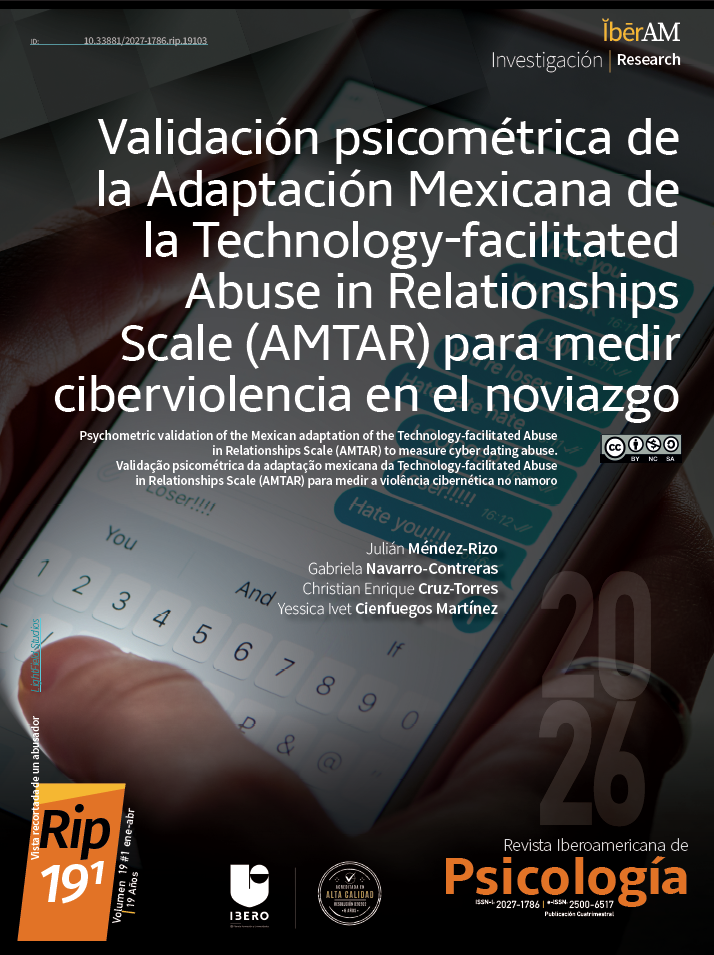
Psychometric validation of the Mexican Adaptation of the Technology-facilitated Abuse in Relationships Scale (AMTAR) to measure cyber-violence in dating.
Validación psicométrica de la Adaptación Mexicana de la Technology-facilitated Abuse in Relationships Scale (AMTAR) para medir ciberviolencia en el noviazgo
Article Sidebar
 PDF (Español (España))
 FLIP
FLIP

Los autores que publican en la Revista Iberoamericana de Psicología están de acuerdo con los siguientes términos:
- El Autor o los autores, desde que presenta(n) a consideración de esta revista su manuscrito, esta(n) informado(s) acerca de la política de Acceso Abierto, como condición indisociable de publicación, lo que significa que ni él(los), ni la revista han de percibir ingreso alguno por concepto de la lectura de resúmenes o del artículo completo, tampoco por su uso o explotación para generar nuevo conocimiento o para desarrollar aprendizajes alrededor de la obra.
- Los autores conservan los derechos de autor y garantizan a la revista el derecho de ser la primera publicación del trabajo, al igual que licenciado bajo una Creative Commons Atribución-NoComercial-CompartirIgual 4.0 Internacionalque permite que permite a terceros utilizar lo publicado, siempre que se haga mención a la autoría del trabajo y la primera publicación en esta revista, no se utilice con fines comerciales y que las obras que se deriven del artículo se compartan en iguales condiciones.
- Los conceptos y opiniones expresados en los artículos son responsabilidad exclusiva de los autores y no comprometen a la Revista Iberoamericana de Psicología ni a la Corporación Universitaria Iberoamericana. Los contenidos de esta revista se distribuyen bajo licencia de tipo Creative Commons Atribución 4.0 Internacional, la cual exige el debido reconocimiento de las obras y cuyos términos se encuentran en: https://creativecommons.org/licenses/by/4.0/deed.es
- La Revista Iberoamericana de Psicología es una revista de acceso abierto, por lo que tanto el proceso editorial como los contenidos publicados están disponibles para todos los usuarios sin cargo alguno: la Revista no realiza cobro alguno por acceso, lectura o descarga de contenidos ni por procesos o actividades de la editorial con fines de publicación.
Citations



Main Article Content
Dating relationships have been influenced by the advancement of new technologies and digital spaces. This development has given rise to a new issue within couple dynamics: cyber dating violence. Various scales have been used to measure cyber dating violence, such as the TAR Scale, which assesses the frequency of cyber dating violence experiences in the past year. Objective: To perform a cultural adaptation and psychometric validation of the TAR Scale in a population of Mexican university students. Method: An instrumental study was conducted with a sample of 255 Mexican university students. The psychometric validation included item discrimination analysis using Student’s t-test, internal consistency analysis through McDonald’s Omega and Cronbach's alpha. Construct validity evidence was obtained using exploratory factor analysis with generalized least squares and promax rotation. Results: Values of KMO=.903, Bartlett’s chi²<.001, and a three-factor structure with eigenvalues greater than 1 were obtained, explaining 66.3% of the total variance and showing internal consistency (ω=.89-.91, α=.86-.90) across 14 items. Discussion: This version demonstrates adequate cultural adaptation, good internal consistency indices, and construct validity evidence for measuring cyber dating violence in samples of Mexican university students.







Downloads
Article Details
Aguilar-Hernández, M., Uscanga-Almaraz, V. & Blanco-Enríquez, F. (2022). Conductas sobre sexting en adolescentes mexicanos de secundaria y preparatoria. Sociedad e Infancias, 6(2),139-150. https://dx.doi.org/10.5209/soci.84002
Alvídrez, S. & Rojas-Solís, J. L. (2017). Los amantes en la época del smartphone: Aspectos comunicativos y psicológicos relativos al inicio y mantenimiento de la relación romántica. Global Media Journal, 14(27), 1-18. https://www.redalyc.org/pdf/687/68753898001.pdf
Asensio, N. (2019). Las nuevas tecnologías y su influencia en las relaciones interpersonales. La Razón Histórica, (42), 179-193. http://hdl.handle.net/10201/67479
Bentler, P. M. & Bonett, D. G. (1980). Significance tests and goodness of fit in the analysis of covariance structures. Psychological Bulletin, 88(3), 588-606. https://doi.org/10.1037/0033-2909.88.3.588
Brown, C. & Hegarty, K. (2021). Development and validation of the TAR Scale: A measure of technology-facilitated abuse in relationships. Computers in Human Behavior Reports, 3. https://doi.org/10.1016/j.chbr.2021.100059
Brown, C. & Hegarty, K. (2024). Fear and distress: How can we measure the impact of technology-facilitated abuse in relationships? Social Sciences, 13(71), 1-16. https://doi.org/10.3390/socsci13010071
Brown, C., Flood, M. & Hegarty, K. (2022). Digital dating abuse perpetration and impact: The importance of gender. Journal of Youth Studies, 25(2), 193-208. https://doi.org/10.1080/13676261.2020.1858041
Browne, M. W. & Cudeck, R. (1993). Alternative ways of assessing model fit. En K. A. Bollen y J. S. Long (Eds.), Testing structural equation models (pp. 136-162). Sage.
Byrne, B. M. (1998). Structural equation modeling with LISREL, PRELIS, and SIMPLIS: Basic concepts, applications, and programming. Lawrence Erlbaum Associates Publishers.
Calvete, E., Fernández-González, L., Orue, I., Machimbarrena, M. & González-Cabrera, J. (2021). Validación de un cuestionario para evaluar el abuso en relaciones de pareja en adolescentes (CARPA), sus razones y las reacciones. Revista de Psicología Clínica con Niños y Adolescentes, 8(1), 60-69. http://doi.org/10.21134/rpcna.2021.08.1.8
Domínguez, A. C., Aguilera, S., Acosta, T. T., Navarro, G. & Ruiz, Z. (2012). La deseabilidad social revalorada: Más que una distorsión, una necesidad de aprobación social. Acta de Investigación Psicológica, 2(3), 808-824. http://www.redalyc.org/articulo.oa?id=358933342005
Domínguez, R. A. (2019). El ciberacoso en Tamaulipas: caracterización, conductas y violencias asociadas. El Colegio de Tamaulipas.
Durkin, K. (2018). Cyberstalking. SAGE Publications, Inc, 3,165-167. https://doi.org/10.4135/9781473960367
Euan, A. J. & Pinto, M. F. (2022). Variables asociadas a la violencia digital de pareja en una muestra de adultos jóvenes de Yucatán, México, entre el 2015 y 2020. Revista Logos Ciencia & Tecnología, 14(3), 73-85. https://doi.org/10.22335/rlct.v14i3.1609
Federación Nacional de Colegios, Sociedades y Asociaciones de Psicólogos de México, A. C. (2018). Código de Ética de las y los psicólogos mexicanos. Autor.
González-Ortega, J. L., Romero-Méndez, C. A., Rojas-Solís, J. L. & López, V. A. (2020). Violencia off line y on line en la pareja de adolescentes mexicanos. Civilizar: Ciencias Sociales y Humanas, 20(38), 65-80. https://doi.org/10.22518/jour.ccsh/2020.1a09
Hidalgo-Rasmussen, C. A., Javier-Juárez, P., Zurita-Aguilar, K., Yanez-Peñúñuri, L. Y., Franco-Paredes, K. & Chávez-Flores, Y. V. (2020). Adaptación transcultural del “Cuestionario de abuso cibernético en la pareja” (CDAQ) para adolescentes mexicanos. Behavioral Psychology/Psicología Conductual, 28(3), 435-453. https://www.behavioralpsycho.com/wp-content/uploads/2020/12/04.Hidalgo_28-3-1.pdf
Hooper, D., Coughlan, J. & Mullen, M. R. (2008). Structural Equation Modelling: Guidelines for Determining Model Fit. The Electronic Journal of Business Research Methods, 6(1), 53-60. https://core.ac.uk/download/pdf/297019805.pdf
Hu, L. & Bentler, P. M. (1999). Cutoff criteria for fit indexes in covariance structure analysis: Conventional criteria versus new alternatives. Structural Equation Modeling: A Multidisciplinary Journal, 6(1), 1-55. https://doi.org/10.1080/10705519909540118
Jaen-Cortés, C. I., Rivera-Aragón, S., Reidl-
Martínez, L. M. & García-Méndez, M. (2017). Violencia de pareja a través de medios electrónicos en adolescentes mexicanos. Acta de Investigación Psicológica, 7, 2593-2605. http://doi.org/10.1016/j.aipprr.2017.01.001
Jasp Team. (2024). JASP (Version 0.19.0) [Computer software]. https://jasp-stats.org
Juárez, K. (2022). El meme digital como herramienta política en México. Cuicuilco. Revista de Ciencias Antropológicas, (85), 215-238. https://www.scielo.org.mx/pdf/crca/v29n85/2448-8488-crca-29-85-215.pdf
López, L. (2020). El chiste y su uso contemporáneo. Un acercamiento a partir de Freud y Lacan. Ciencia Ergo Sum, 27(2), 1-9. https://doi.org/10.30878/ces.v27n2a11
Martínez, A. & Ibabe, I. (2022). Recommended instruments for analyzing cyber dating violence: A systematic review. The Spanish Journal of Psychology, 25, 1.20. https://doi.org/10.1017/SJP.2021.50
Okdie, B. M. & Ewoldsen, D. R. (2018). To boldly go where no relationship has gone before: Commentary on interpersonal relationships in the digital age. The Journal of Social Psychology, 158(4), 508-513. https://doi.org/10.1080/00224545.2018.1473835
Rey, C. A., Ocampo, E. M. & Martínez, J. A. (2023). Ciberviolencia en el noviazgo: Diferencias por edad, sexo y variables relacionadas on la victimización. Suma Psicológica, 30(2), 40-48. https://doi.org/10.14349/sumapsi.2023.v30.n2.5
Rial, A., Gómez, P., Varela, J. & Braña, T. (2014). Actitudes, percepciones y uso de Internet y las redes sociales entre los adolescentes de la comunidad gallega (España). Anales de psicología, 30(2), 642-655. https://doi.org/10.6018/analesps.30.2.159111
Rizo, M. (2013). Comunicación interpersonal digital y nuevas formas de comunidad. Reflexiones sobre la comunicación pos-masiva. Imagonautas, 3(2), 52-65. https://dialnet.unirioja.es/descarga/articulo/4781884.pdf
Rojas-Alonso, I. & Fuentes, E. (2023). Ciberviolencia de pareja y su relación con la sintomatología de depresión, ansiedad y estrés en jóvenes universitarios mexicanos. Dilemas Contemporáneos: Educación, Política y Valores, 11(1), 1-21. https://doi.org/10.46377/dilemas.v11i1.3739
Romo-Tobón, R. J., Vázquez-Sánchez, V., Rojas-Solís, J. L. & Alvídrez, S. (2020). Cyberbullying y ciberviolencia de pareja en alumnado de una universidad privada mexicana. Propósitos y Representaciones, 8(2), 1-18. https://doi.org/10.20511/pyr2020.v8n2.303
Sánchez-Hernández, M. D., Herrera-Enríquez, M. C. & Expósito, F. (2020). Controlling behaviors in couple relationships in the digital age: Acceptability of gender violence, sexism, and myths about romantic love. Psychosocial Intervention, 29(2), 67-81. https://doi.org/10.5093/pi2020a1
Sotres, C. (2009). Me duele cuando me río: El humor visto por una cabaretera. Karpa 2(2). http://www.calstatela.edu/misc/karpa/Karpa2.2/Site%20Folder/cecisotres.html
Velázquez, L. M. (2020). Del cortejo hostigante al rompimiento en línea, ciberviolencia en preparatorianos. Revista EDUCA UMCH, (16), 183-202. https://doi.org/10.35756/educaumch.202016.16
Wallace, A., Langevin, R. & Hébert, M. (2023). An analysis of risk and protective factors associated with cyber‑dating violence victimization of adolescent girls: An ecological perspective. Journal of Child & Adolescent Trauma, 16, 1017-1029. https://doi.org/10.1007/s40653-023-00558-6
Xia, Y. & Yang, Y. (2019). RMSEA, CFI, and TLI in structural equation modeling with ordered categorical data: The story they tell depends on the estimation methods. Behavior Research Method, 51, 409-428. https://doi.org/10.3758/s13428-018-1055-2