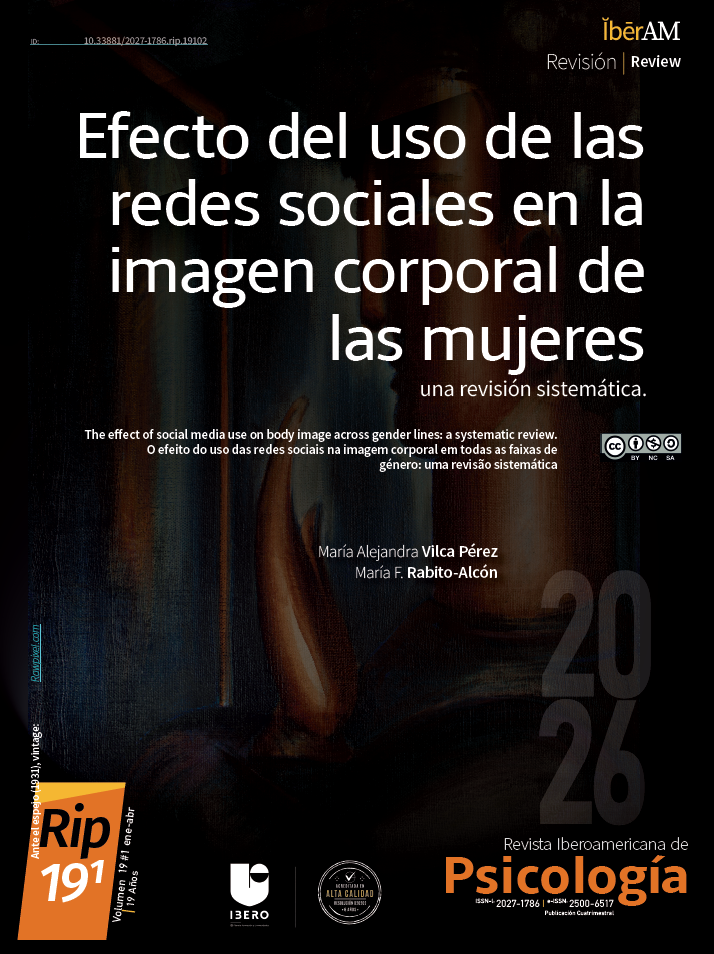
Efecto del uso de las redes sociales en la imagen corporal de las mujeres: una revisión sistemática.
Efecto del uso de las redes sociales en la imagen corporal de las mujeres: una revisión sistemática.
Barra lateral del artículo
 PDF
PDF
 FLIP
FLIP

Los autores que publican en la Revista Iberoamericana de Psicología están de acuerdo con los siguientes términos:
- El Autor o los autores, desde que presenta(n) a consideración de esta revista su manuscrito, esta(n) informado(s) acerca de la política de Acceso Abierto, como condición indisociable de publicación, lo que significa que ni él(los), ni la revista han de percibir ingreso alguno por concepto de la lectura de resúmenes o del artículo completo, tampoco por su uso o explotación para generar nuevo conocimiento o para desarrollar aprendizajes alrededor de la obra.
- Los autores conservan los derechos de autor y garantizan a la revista el derecho de ser la primera publicación del trabajo, al igual que licenciado bajo una Creative Commons Atribución-NoComercial-CompartirIgual 4.0 Internacionalque permite que permite a terceros utilizar lo publicado, siempre que se haga mención a la autoría del trabajo y la primera publicación en esta revista, no se utilice con fines comerciales y que las obras que se deriven del artículo se compartan en iguales condiciones.
- Los conceptos y opiniones expresados en los artículos son responsabilidad exclusiva de los autores y no comprometen a la Revista Iberoamericana de Psicología ni a la Corporación Universitaria Iberoamericana. Los contenidos de esta revista se distribuyen bajo licencia de tipo Creative Commons Atribución 4.0 Internacional, la cual exige el debido reconocimiento de las obras y cuyos términos se encuentran en: https://creativecommons.org/licenses/by/4.0/deed.es
- La Revista Iberoamericana de Psicología es una revista de acceso abierto, por lo que tanto el proceso editorial como los contenidos publicados están disponibles para todos los usuarios sin cargo alguno: la Revista no realiza cobro alguno por acceso, lectura o descarga de contenidos ni por procesos o actividades de la editorial con fines de publicación.
Citaciones



Contenido principal del artículo

En la actualidad, existe una estrecha relación entre la imagen corporal y el uso de las redes sociales, particularmente durante la preadolescencia y la juventud. Se realizó una revisión sistemática utilizando las palabras clave: género, redes sociales e imagen corporal. Tras aplicar los criterios de inclusión y exclusión, se seleccionaron 21 estudios. Este trabajo tiene como objetivo examinar cómo el uso constante de las redes sociales afecta de manera diferente a hombres y mujeres, destacando la presión que recae sobre ambos géneros. Las conclusiones revelan que el género es un factor clave en la manera en que las redes sociales afectan la imagen corporal y la insatisfacción corporal, siendo las mujeres las más afectadas en términos generales. Sin embargo, los hombres se ven más impactados en aspectos específicos como la masa muscular. Finalmente, se sugiere que estos factores pueden contribuir al desarrollo de trastornos alimentarios y otros problemas de salud relacionados.







Descargas
Detalles del artículo
American Psychological Association. (2018). Imagen corporal. APA Dictionary of Psychology. https://dictionary.apa.org/body-image
Arjona A., Montserrat M., y Checa, J. (2024). Use of Social Media, Satisfaction with Body Image, and the Risk of Manifesting Eating Disorders. Social Sciences, 13: 105. https://doi.org/10.3390/socsci13020105
Bradley, S., Nesi, J., Widman, L., & Galla, B. M. (2019). The Appearance-Related Social Media Consciousness Scale: Development and validation with adolescents. Body image, 33, 164–174. https://doi.org/10.1016/j.bodyim.2020.02.017
Calzo, J. P., Sonneville, K. R., Haines, J., Blood, E. A., Field, A. E. & Austin, S. B. (2012). The development of associations among body mass index, body dissatisfaction, and weight and shape concern in adolescent boys and girls. The Journal of adolescent health : official publication of the Society for Adolescent Medicine, 51(5), 517–523. https://doi.org/10.1016/j.jadohealth.2012.02.021
Camacho, P., Díaz, A., & Sabariego, J. (2023). Relación entre el uso de Instagram y la imagen corporal de los adolescentes. Apuntes de Psicología, 41(2), 117-122. https://doi.org/10.55414/ap.v41i2.1537
Choukas-Bradley, S., Nesi, J., Widman, L., & Higgins, M. K. (2019). Camera-ready: Young women’s appearance-related social media consciousness. Psychology of Popular Media Culture, 8(4), 473-481. https://doi.org/10.1037/ppm0000196
Cohrdes, C., Santos, C., Kajikhina, K., & Hölling, H. (2021) The role of weight- and appearance-related discrimination on eating disorder symptoms among adolescents and emerging adults. BMC Public Health 21. https://doi.org/10.1186/s12889-021-11756-y
Coyne, S., Weinstein, E., Sheppard, A., James, S., Gale, M., Van Alfen, M., Ririe, N., Monson, C., Ashby, S., Weston, A., & Banks, K. (2023). Analysis of Social Media Use, Mental Health, and Gender Identity Among US Youths. JAMA network open, 6(7). https://doi.org/10.1001/jamanetworkopen.2023.24389
Díaz C. (2024). La huella de Instagram en la imagen corporal de los jóvenes: una revisión teórica sistemática. Trabajo Fin de Máster. Universidad de Alcalá, 4-12. http://hdl.handle.net/10017/61515
DiBisceglie, S., & Arigo, D. (2021) Perceptions of #fitspiration activity on Instagram: Patterns of use, response, and preferences among fitstagrammers and followers. J Health Psychol. (8) 1233-1242. https://doi.org/10.1177/1359105319871656
Digennaro, S., & Iannaccone, A. (2023). Check Your Likes but Move Your Body! How the Use of Social Media Is Influencing Pre-Teens Body and the Role of Active Lifestyles. Sustainability, 15(4), 3046. https://doi.org/10.3390/su15043046
Ding N., & Xu Z. (2023). China Adolescents Comparisons on Social Media and Emotional Eating: A Moderated Analysis: C & A. Child & Adolescent Social Work Journal, 40(1), 107-117. https://doi.org/10.1007/s10560-021-00750-3
Durán, S., & Miranda, M. (2016). Comparación en autopercepción de la imagen corporal en estudiantes universitarios evaluados según Índice de Masa Corporal y porcentaje de grasa. Revista Española de Nutrición Humana y dietética, 20. https://dx.doi.org/10.14306/renhyd.20.3.209
Duno, M., & Acosta, E. (2019). Percepción de la imagen corporal en adolescentes universitarios. Revista Chilena de Nutrición, 46(5), 545-553. http://dx.doi.org/10.4067/S0717-75182019000500545
Dzielska, A., & Woynarowska, M. (2022). Psychosocial Predictors of Body Weight Congruence in Adolescents Aged 15 and 17 Years in Poland: Findings from the Health Behaviour in School-Aged Children (HBSC) Study. International journal of environmental research and public health, 19(4). https://doi.org/10.3390/ijerph19042342
Fardouly, J., Diedrichs, P. C., Vartanian, L. R. & Halliwell, E. (2015). Social comparisons on social media: the impact of Facebook on young women's body image concerns and mood. Body image, (13), 38–45. https://doi.org/10.1016/j.bodyim.2014.12.002
Gaibor, S., & Marcelo, D. (2024). Insatisfacción corporal y riesgo de trastorno de conducta alimentaria en adultos jóvenes. Salud con ciencia. Revista de Ciencias de la Salud., 3(1), 10-14. https://doi.org/10.55204/scc.v3i1.e65
Harris, J., Duncan, A., Men, V., Shevick, N., Krauss, M., & Cabazos, P. (2018). Messengers and Messages for tweets that used #thinspo and #fitspo hashtags in 2016. Preventing Chronic Disease, 15. doi: https://doi.org/10.5888/pcd15.170309
Khalaf, A., Hashmi, I., & Omari, O. (2021). The Relationship between Body Appreciation: and Self-Esteem and Associated Factors among Omani University Students: An Online Cross-Sectional Survey. Journal of obesity, 2021(1), 3-7. https://doi.org/10.1155/2021/5523184
Kircaburun, K., Griffiths, M. D., &Billieux, J. (2020). Childhood Emotional Maltreatment and Problematic Social Media Use Among Adolescents: The Mediating Role of Body Image Dissatisfaction.International. Journal of Mental Health and Addiction, 18(6), 1536-1547. https://doi.org/10.1007/s11469-019-0054-6
Ladera, I. (2016). La satisfacción con la imagen corporal: su relación con las redes sociales y la autoestima. Repositorio Comillas. 7-13. http://hdl.handle.net/11531/13133
Lindvall, C., Sundgot-Borgen, C., Lundin I., Wennersberg A., & Wisting, L. (2024). Further evidence of the association between social media use, eating disorder pathology and appearance ideals and pressure: a cross-sectional study in Norwegian adolescents. Journal of Eating Disorders, 12, 1-13. https://doi.org/10.1186/s40337-024-00992-3
Maganto, C., & Cruz, S. (2000). “La imagen corporal y los trastornos alimenticios: una cuestión de género”. Cuadernos de Psiquiatría y Psicoterapia del niño y del adolescente, Madrid, 30, 45-48.
Mahon, C., & Hevey, D. (2022). Pilot trial of a self-compassion intervention to address adolescents' social media-related body image concerns. Clinical child psychology and psychiatry, 28(1), 307–322. https://doi.org/10.1177/13591045221099215
Marín, R., Wendolyn, M., & Pineda, L. (2023). Relación de la insatisfacción corporal y la identificación grupal en hombres y mujeres universitarios durante el Covid19. Journal of Behavior, Health & Social Issues, 15(2), 47-54. https://doi.org/10.22201/fesi.20070780e.2023.15.2.81311
Mayoh, J., & Jones, I. (2021). Young People's Experiences of Engaging With Fitspiration on Instagram: Gendered Perspective. Journal of medical Internet research, 23(10). https://doi.org/10.2196/17811
Mohsenpour, M. A., Karamizadeh, M., Barati-Boldaji, R., Ferns, G. A., & Akbarzadeh, M. (2023). Structural equation modeling of direct and indirect associations of social media addiction with eating behavior in adolescents and young adults. Scientific Reports (Nature Publisher Group), 13(1), 3044. https://doi.org/10.1038/s41598-023-29961-7
Papapanou, T., Darviri, C., Kanaka, C., Tigani, X., Michou, M., Vlachakis, D., Chrousos, G., & Bacopoulou, F. (2023). Correlations between Social Appearance Anxiety, Use of Social Media, and Feelings of Loneliness in Adolescents and Young Adults. International Environenment Public Health. https://doi.org/10.3390/ ijerph20054296
Perkins, D. F., & Lerner, R. M. (1995). Single and multiple indicators of physical attractiveness and psychosocial behaviors among young adolescents. The Journal of Early Adolescence, 15(3), 269–298. https://doi.org/10.1177/0272431695015003001
Pop, L., Iorga, M., & Iurcov, R. (2022). Body-Esteem, Self-Esteem and Loneliness among Social Media Young Users. International journal of environmental research and public health, 19(9), 5-12. https://doi.org/10.3390/ijerph19095064
Rabito- Alcón, M.F. (2015). Insatisfacción corporal: dismorfia muscular, trastornos de la conducta alimentaria y disforia de género. UAM. Departamento de psicología Biológica y de la Salud. 15-28. http://hdl.handle.net/10486/669593
Ramos, P., Rivera, F., Pérez, R., Lara, L., & Moreno, C. (2016). Diferencias de género en la imagen corporal y su importancia en el control de peso. Escritos de Psicología – Psychological Writings, 9(1), 42-50. https://dx.doi.org/10.5231/psy.writ.2015.1409
Rodgers, R., Slater, A., Gordon, S., McLean, A., Jarman, K., & Paxton, J. (2020). A Biopsychosocial Model of Social Media Use and Body Image Concerns, Disordered Eating, and Muscle-Building Behaviors among Adolescent Girls and Boys. Journal of Youth and Adolescence, 49(2), 399-409. https://doi.org/10.1007/s10964-019-01190-0
Rojo, M., Beltrán-Garrayo, L., Del Blanco-Barredo, C., & Sepúlveda R. (2023). Spanish validation of two social media appearance-related constructs associated with disordered eating in adolescents: The Appearance-related Social Media Consciousness scale (ASMC) and the Critical Thinking about Media Messages scale (CTMM). Body image, 45, 401–413. https://doi.org/10.1016/j.bodyim.2023.04.004
Rutsztein, G., Murawski, B., Elizathe, L., & Scappatura, L. (2010). Trastornos alimentarios: detección en adolescentes mujeres y varones de Buenos Aires. Un estudio de doble fase. Revista Mexicana de trastornos alimenticios, 1(1),48 -61.
Smith, O., Mills, J., & Samson, L. (2024). Out of the loop: Taking a one-week break from social media leads to better self-esteem and body image among young women. Body image, 49. https://doi.org/10.1016/j.bodyim.2024.101715
Vaquero, R., Alacid, F., Muyor, J. U., & López, P. (2013). Imagen corporal; revisión bibliográfica. Nutritional Hospital. 28(1). 27-35. https://dx.doi.org/10.3305/nh.2013.28.1.6016
Villanueva-Tobaldo, C. V., Martín-Rodríguez, A., & Clemente-Suárez, V. J. (2024). Body Perceptions and Psychological Well-Being: A Review of the Impact of Social Media and Physical Measurements on Self-Esteem and Mental Health with a Focus on Body Image Satisfaction and Its Relationship with Cultural and Gender Factors. Healthcare, 12(14), 5-34. https://doi.org/10.3390/healthcare12141396
Vuong, A. T., Jarman, H. K., Doley, J. R., & McLean, S. A. (2021). Social Media Use and Body Dissatisfaction in Adolescents: The Moderating Role of Thin- and Muscular-Ideal Internalisation. International journal of environmental research and public health, 18(24), 13222. https://doi.org/10.3390/ijerph182413222
Wu, Y., Xue, Y., Zhao, X., Han, S., & Wu, W. (2024). Unravelling the veil of appearance anxiety: exploring social media use among Chinese young people. BMC Psychology, 12, 1-11. https://doi.org/10.1186/s40359-023-01495-7
Xu, K., Liang, C., Zhao, Y., Zhang, F., Zhang, C., Zhang, Y., Zhang, Y., & Jiang, Z. (2024). Psychometric evaluation of the Chinese version of the Scale of Effects of social media on Eating Behaviour and research of its influencing factors. BMC Public Health, 24, 1-16. https://doi.org/10.1186/s12889-024-17923-1
Yang, J., Fardouly, J., Wang, Y., & Shi, W. Selfie-Viewing and Facial Dissatisfaction among Emerging Adults: A Moderated Mediation Model of Appearance Comparisons and Self-Objectification. Int J Environ Res Public Health. 2020; 17(2). https://doi.org/10.3390/ijerph17020672