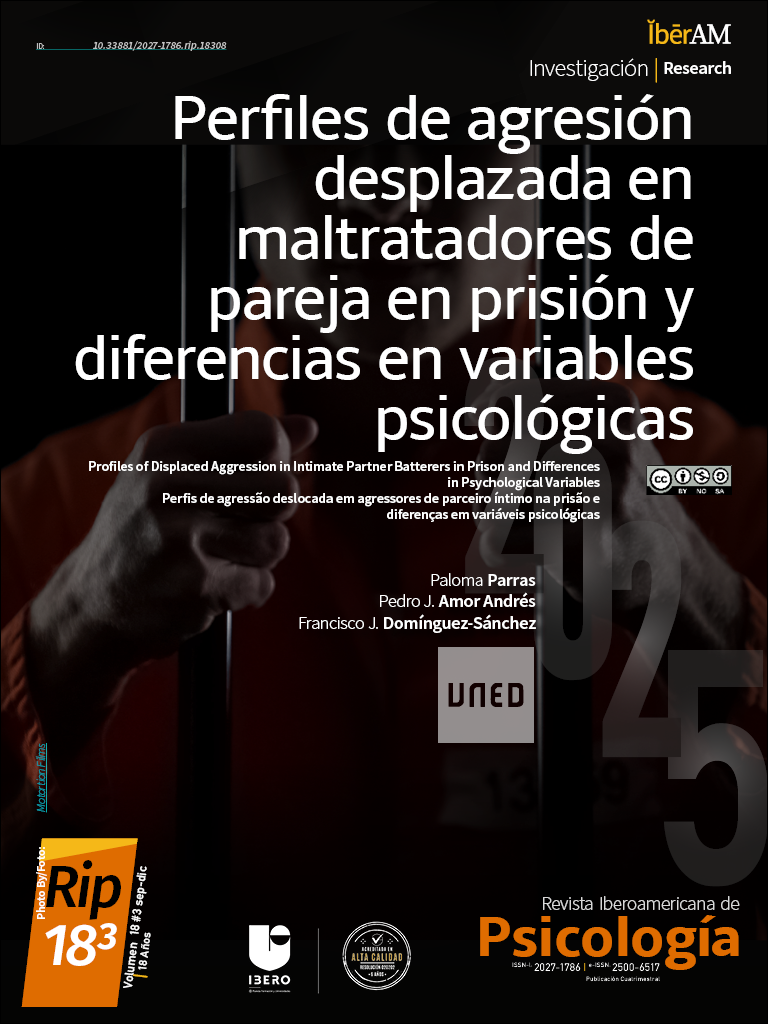
Perfis de agressão deslocada em agressores de parceiro na prisão e diferenças em variáveis psicológicas.
PERFILES DE AGRESORES DE PAREJA
Barra lateral de artigos
 PDF (Español (España))
 FLIP
FLIP
 XML (Español (España))

Los autores que publican en la Revista Iberoamericana de Psicología están de acuerdo con los siguientes términos:
- El Autor o los autores, desde que presenta(n) a consideración de esta revista su manuscrito, esta(n) informado(s) acerca de la política de Acceso Abierto, como condición indisociable de publicación, lo que significa que ni él(los), ni la revista han de percibir ingreso alguno por concepto de la lectura de resúmenes o del artículo completo, tampoco por su uso o explotación para generar nuevo conocimiento o para desarrollar aprendizajes alrededor de la obra.
- Los autores conservan los derechos de autor y garantizan a la revista el derecho de ser la primera publicación del trabajo, al igual que licenciado bajo una Creative Commons Atribución-NoComercial-CompartirIgual 4.0 Internacionalque permite que permite a terceros utilizar lo publicado, siempre que se haga mención a la autoría del trabajo y la primera publicación en esta revista, no se utilice con fines comerciales y que las obras que se deriven del artículo se compartan en iguales condiciones.
- Los conceptos y opiniones expresados en los artículos son responsabilidad exclusiva de los autores y no comprometen a la Revista Iberoamericana de Psicología ni a la Corporación Universitaria Iberoamericana. Los contenidos de esta revista se distribuyen bajo licencia de tipo Creative Commons Atribución 4.0 Internacional, la cual exige el debido reconocimiento de las obras y cuyos términos se encuentran en: https://creativecommons.org/licenses/by/4.0/deed.es
- La Revista Iberoamericana de Psicología es una revista de acceso abierto, por lo que tanto el proceso editorial como los contenidos publicados están disponibles para todos los usuarios sin cargo alguno: la Revista no realiza cobro alguno por acceso, lectura o descarga de contenidos ni por procesos o actividades de la editorial con fines de publicación.
Citações



Conteúdo do artigo principal
A complexidade da violência por parceiro íntimo (VPI) exige investigar as características dos agressores. Esta investigação explora a inter-relação entre a agressão deslocada (AD) e outros construtos de interesse, em homens que estão na prisão por um crime de VPI. Especificamente, o objetivo do estudo é identificar perfis latentes em função da AD e compará-los em ruminação em raiva (RR), desejabilidade social (DS), apego adulto (AA) e regulação emocional cognitiva (REC). Participaram 196 agressores (M = 41,2 anos, DT = 11,2) que cumpriam pena na Espanha. Como resultado, foram identificados três perfis de agressores (AD-Alta, AD-Média e AD-Baixa) de acordo com as pontuações obtidas no Questionário de Agressão Deslocada. Esses perfis são consistentes com as pontuações obtidas na Escala de RR. Além disso, os grupos de AD-Alta e AD-Média pontuaram mais do que o de AD-Baixa nas dimensões de Baixa autoestima e Ressentimento/Possessividade e na estratégia REC Culpar os Outros. Em contrapartida, o grupo de AD-Baixa pontuou mais em DS e na expressão de sentimentos de AA do que os outros dois grupos. Por fim, os grupos de AD-Alta e AD-Média eram muito semelhantes em RR, DS, AA e REC. Conclui-se que a DS pode influenciar na autoavaliação da AD e que determinadas variáveis (Catastrofização, Culpabilização dos outros, Baixa autoestima, Ressentimento/possessividade e Autossuficiência emocional) são relevantes na AD. Destaca-se a utilidade do AA e do REC na intervenção terapêutica com homens que praticam VPI.







Downloads
Detalhes do artigo
Alexander, E. F., & Johnson, M. D. (2023). On categorizing intimate partner violence: A systematic review of exploratory clustering and classification studies. Journal of Family Psychology, 37(5), 743–752. https://doi.org/10.1037/fam0001075
American Psychiatric Association. (2013). Diagnostic and statistical manual of mental disorders (5th ed.). https://doi.org/10.1176/appi.books.9780890425596
Amor, P. J., Echeburúa, E., & Bohórquez (2020). Psicología forense y derecho penal (III): lesiones psíquicas y secuelas emocionales en víctimas adultas de delitos violentos. En M. A. Carrasco & F. Rubio-Garay (Eds.). Psicología jurídica y forense. Volumen 2: ámbitos de aplicación (pp. 221-277). Sanz y torres.
Amor, P. J., Echeburúa, E., & Loinaz, I. (2009). ¿Se puede establecer una clasificación tipológica de los hombres violentos contra su pareja? International Journal of Clinical and Health Psychology, 9(3), 519-539. https://www.aepc.es/ijchp/articulos_pdf/ijchp-336.pdf
Bookwala, J., & Zdaniuk, B. (1998). Adult attachment styles and aggressive behavior within dating relationships. Journal of Social and Personal Relationships, 15, 175-190. https://doi.org/10.1177/0265407598152003
Boyle, G. J., Saklofske, D. H., & Matthews, G. (2015). Criteria for selection and evaluation of scales and measures. In G. J. Boyle, D. H. Saklofske, & G. Matthews (Eds.), Measures of personality and social psychological constructs (pp. 3–15). Elsevier Academic Press. https://doi.org/10.1016/B978-0-12-386915-9.00001-2
Cavanough, M. M., & Gelles, R. J. (2005). The utility of male domestic violence offender typologies: New directions for research, policy, and practice. Journal of Interpersonal Violence, 20, 155-166. https://doi.org/10.1177/0886260504268763
Crowne, D. P., & Marlowe, D. (1960). A new scale of social desirability independent of psychopathology. Journal of Consulting Psychology, 24(4), 349–354. https://doi.org/10.1037/h0047358
Davis, C. G., Doherty, S., & Moser, A. E. (2014). Social desirability and change following substance abuse treatment in male offenders. Psychology of Addictive Behaviors, 28(3), 872–879. https://doi.org/10.1037/a0037528
De la Osa-Subtil, I., Mateo, P. V., Arias, A., & de Dios-Duarte, M. J. (2024). IPVAW male perpetrators convicted in Spain: a typology and characterization based on latent class analysis. Frontiers in Psychology, 15, 1353809. https://doi.org/10.3389/fpsyg.2024.1353809
Denson, T. F. (2013). The multiple systems model of angry rumination. Personality and social psychology review: an official journal of the Society for Personality and Social Psychology, Inc, 17(2), 103–123. https://doi.org/10.1177/1088868312467086
Denson, T. F., Pedersen, W. C., Friese, M., Hahm, A., & Roberts, L. (2011). Understanding Impulsive Aggression: Angry Rumination and Reduced Self-Control Capacity Are Mechanisms Underlying the Provocation-Aggression Relationship. Personality and Social Psychology Bulletin, 37(6), 850-862. https:// doi.org/10.1177/0146167211401420
Denson, T. F., Pedersen, W. C., & Miller, N. (2006). The displaced aggression questionnaire. Journal of Personality and Social Psychology, 90(6), 1032–1051. https://doi.org/10.1037/0022-3514.90.6.1032
Dixon, L., & Graham-Kevan, N. (2011). Understanding the nature and etiology of intimate partner violence and implications for practice and policy. Clinical Psychology Review, 31(7), 1145–1155. https://doi.org/10.1016/j.cpr.2011.07.001
Domínguez-Sánchez, F. J. (2010). La alegría, la tristeza y la ira. In E. G.
Fernández-Abascal, B. García, M. P. Jiménez, M. D. Díaz, & F. J. Domínguez-Sánchez, Psicología de la emoción (pp. 267-338). Editorial Universitaria Ramón Areces.
Eckhardt, C., Samper, R., & Murphy, C. (2008). Anger disturbance among perpetrators of intimate partner violence. Clinical characteristics and outcomes of court-mandated treatment. Journal of Interpersonal Violence, 23, 1600-1617. https://doi.org/10.1177/0886260508314322
Feeney, J. A., & Karantzas, G. C. (2017). Couple conflict: Insights from an attachment perspective. Current Opinion in Psychology, 13, 60-64. https://doi.org/10.1016/j.copsyc.2016.04.017
Fernández-González, L., O'Leary, K. D., & Muñoz-Rivas, M. J. (2013). We are not joking: need for controls in reports of dating violence. Journal of Interpersonal Violence, 28(3), 602-620. https://doi.org/10.1177/0886260512455518
Ferrando, P. J., & Chico, E. (2000). Adaptación y análisis psicométrico de la Escala de Deseabilidad Social de Marlowe y Crowne. Psicothema, 12(3), 383–389. https://www.psicothema.com/pdf/346.pdf
García-Sancho, E., Salguero, J. M., Vasquez, E. A., & Fernández-Berrocal, P. (2016). Validity and reliability of the Spanish version of the Displaced Aggression Questionnaire: a pilot study. Psicothema, 28(1), 96-101. https://doi.org/10.7334/psicothema2015.222
Garnefski, N., Kraaij, V., & Spinhoven, Ph. (2001). Negative life events, cognitive emotion regulation and emotional problems. Personality and Individual Differences, 30, 1311-1327. https://doi.org/10.1016/S0191-8869(00)00113-6
Hair, J. F., Black, W. C., Babin, B. J., & Anderson, R. E. (2019). Multivariate Data Analysis, Eighth Edition. Cengage.
Holgado-Tello, F. P., Amor, P. J., Lasa-Aristu, A., Domínguez-Sánchez, F. J., & Delgado, B. (2018). Dos nuevas versiones breves del Cognitive Emotion Regulation Questionnaire y su relación con la depresión y ansiedad. Anales de Psicología / Annals of Psychology, 34(3), 458–464. https://doi.org/10.6018/analesps.34.3.306531
Holtzworth-Munroe, A., Meehan, J. C., Herron, K., Rehman, U., & Stuart, G. L. (2000). Testing the Holtzworth-Munroe and Stuart (1994) batterer typology.
Journal of Consulting and Clinical Psychology, 68, 1000-1019. https://doi.org/10.1037/0022-006X.68.6.1000
IBM Corp. Released (2020). IBM SPSS Statistics for Windows, Version 27.0. IBM Corp
Knox, L., Karantzas, G., & Ferguson, E. (2024). The role of attachment, insecurity, and stress in partner maltreatment: A meta-analysis. Trauma, Violence, & Abuse, 25(1), 721-737. https://doi.org/10.1177/15248380231161012
Krumpal, I. (2013). Determinants of social desirability bias in sensitive surveys: A literature review. Quality & Quantity, 47(4), 2025–2047. https://doi.org/10.1007/s11135-011-9640-9
Ley Orgánica 1/1979, de 26 de septiembre, General Penitenciaria. (1979). Boletín Oficial del Estado, 239, 23180-23186. https://www.boe.es/buscar/pdf/1979/BOE-A-1979-23708-consolidado.pdf
Ley Orgánica 1/2004, de 28 de diciembre, de Medidas de Protección Integral contra la Violencia de Género. Boletín Oficial del Estado, 313, 42166-42197. https://www.boe.es/boe/dias/2004/12/29/pdfs/A42166-42197.pdf
Ley Orgánica 3/2018, de 5 de diciembre, de Protección de Datos Personales y Garantía de los Derechos Digitales (2018). Boletín Oficial del Estado, 294, 119788-119857. https://www.boe.es/boe/dias/2018/12/06/pdfs/BOE-A-2018-16673.pdf
López-Martín, E., & Ardura-Martínez, D. (2023) The effect size in scientific publication. Educación XX1, 26(1), 9-17. https://doi.org/10.5944/educxx1.36276
Magán, I., Lozano, J. H., Pérez, M. A., Sukhodolsky, D. G., & Escalona, A. (2016). Psychometric properties of the Spanish adaptation of the Anger Rumination Scale: Evidence of reliability and validity in the general population. The Spanish Journal of Psychology, 19(22), E17. https://doi.org/10.1017/sjp.2016.17
Mauricio, A. M., & Gormley, B. (2001). Male perpetration of physical violence against female partners: The interaction of dominance needs and attachment insecurity. Journal of Interpersonal Violence, 16, 1066-1081. https://doi.org/10.1177/088626001016010006
Melero, R., & Cantero, M. J. (2008). Los estilos afectivos en la población española: un cuestionario de evaluación del apego adulto. Clínica y Salud, 19(1), 83–100. https://scielo.isciii.es/pdf/clinsa/v19n1/v19n1a04.pdf
Mikulincer, M., & Shaver, P. R. (2011). Attachment, anger, and aggression. En P. R. Shaver, & M. Mikulincer (Eds.), Human aggression and violence. Causes, manifestations, and consequences (pp. 241-257). American Psychological Association. https://doi.org/10.1037/12346-013
Mikulincer, M., & Shaver, P. R. (2024). Implications of attachment processes for emotion regulation. In J. J. Gross & B. Q. Ford (Eds.), Handbook of emotion regulation (3rd ed., pp. 160–166). The Guilford Press.
Milozzi, S., & Marmo, J. (2022). Revisión sistemática sobre la relación entre apego y regulación emocional. Revista Psicología UNEMI, 6(11), 70-86. https://doi.org/10.29076/issn.2602-8379vol6iss11.2022pp70-86p
Murphy, C. M., Taft, C. T., & Eckhardt, C. I. (2007). Anger problem profiles among partner violent men: Differences in clinical presentation and treatment outcome. Journal of Counseling Psychology, 54, 189-200. https://doi.org/10.1037/0022-0167.54.2.189
Niedenthal, P. M., & Ric, F. (2017). Psychology of Emotion (2nd ed.). Routledge.
Norlander, B., & Eckhardt, C. I. (2005). Anger, hostility, and male perpetrators of intimate partner violence: A meta-analytic review. Clinical Psychology Review, 25, 119-152. https://doi.org/10.1016/j.cpr.2004.10.001
Parras, P., Amor, P. J., Domínguez-Sánchez, F. J. y Herrera, M. J. (2025). Cuestionario de Regulación Emocional Cognitiva en personas condenadas por un delito de violencia de género. Anuario de Psicología Jurídica. Avance online. https://doi.org/10.5093/apj2025a11
Reynolds, W. M. (1982). Development of reliable and valid short forms of the Marlowe - Crowne Scale of Social Desirability. Journal of Clinical Psychology, 38(1), 119-125. https://doi.org/10.1002/1097-4679(198201)38:1<119::AID-JCLP2270380118>3.0.CO;2-I
Roberton, T., Daffern, M., & Bucks, R. (2014). Maladaptive emotion regulation and aggression in adult offenders. Psychology, Crime and Law, 20(10), 933-954. https://doi.org/10.1080/1068316X.2014.893333
Roberton, T., Daffern, M., & Bucks, R. S. (2015). Beyond anger control: Difficulty attending to emotions also predicts aggression in offenders. Psychology of Violence, 5(1), 74–83. https://doi.org/10.1037/a0037214
Rogers, R. y Bender, S. D. (2018). Clinical Assessment of Malingering and Deception (4th Ed.). Guilford.
Romero, Á., Lila, M., & Moya-Albiol, L. (2019). The Importance of Considering Alexithymia during Initial Stages of Intimate Partner Violence Interventions to Design Adjuvant Treatments. International Journal of Environmental Research and Public Health, 16, 3695. https://doi.org/10.3390/ijerph16193695
Rosenberg, J., Beymer, P., Anderson, D., Van Lissa, C., & Schmidt, J. (2021). tidyLPA: Easily Carry Out Latent Profile Analysis (LPA) Using Open-Source or Commercial Software. [R package]. Retrieved from https://CRAN.R-project.org/package=tidyLPA.
Ruiz-Pamies, M., Lorenzo-Seva, U., Morales-Vives, F., Cosi, S., & Vigil-Colet, A. (2014). I-DAQ: a new test to assess direct and indirect aggression free of response bias. The Spanish Journal of Psychology, 17, E41. https://doi.org/10.1017/sjp.2014.43
Spencer, C. M., Keilholtz, B. M., & Stith, S. M. (2021). The association between attachment styles and physical intimate partner violence perpetration and victimization: A meta‐analysis. Family Process, 60(1), 270–284. https://doi.org/10.1111/famp.12545
Spielberger, C. D. (1988). Manual for the State-Trait Anger Expression Inventory. Psychological Assessment Resources. https://doi.org/10.1037/t29496-000
Stevens, F. L. (2014). Affect regulation styles in avoidant and anxious attachment. Individual Differences Research, 12(3), 123-130.
Sukhodolsky, D. G., Golub, A., & Cromwell, E. N. (2001). Development and validation of the anger rumination scale. Personality and Individual Differences, 31(5), 689-700. https://doi.org/10.1016/S0191-8869(00)00171-9
The jamovi project (2023). jamovi. (Version 2.4) [Computer Software]. Retrieved from https://www.jamovi.org.
Tweed, R. G., & Dutton, D. G. (1998). A comparison of impulsive and instrumental subgroups of batterers. Violence and Victims, 13, 217-230. https://doi.org/10.1891/0886-6708.13.3.217
Veggi, S., Benfante, A., Di Tella, M., Roveta, F., Castelli, L., & Zara, G. (2024). Intimate Partner Violence and Alexithymia: Do Emotions Matter? A Systematic Review and Meta-Analysis. Trauma, Violence & Abuse, 25(3), 2521–2534. https://doi.org/10.1177/15248380231217045
Velotti, P., Garofalo, C., Callea, A., Bucks, R. S., Roberton, T., & Daffern, M. (2016). Exploring Anger Among Offenders: The Role of Emotion Dysregulation and Alexithymia. Psychiatry, Psychology and Law, 24(1), 128–138. https://doi.org/10.1080/13218719.2016.1164639
Velotti, P., Rogier, G., Beomonte Zobel, S., Chirumbolo, A., & Zavattini, G. C. (2020). The relation of anxiety and avoidance dimensions of attachment to intimate partner violence: A meta-analysis about perpetrators. Trauma,
Violence & Abuse, 23(1), 196-212. https://doi.org/10.1177/1524838020933864
Vignola-Lévesque, C., & Léveillée, S. (2022). Intimate Partner Violence and Intimate Partner Homicide: Development of a Typology Based on Psychosocial Characteristics. Journal of Interpersonal Violence, 37(17–18), 15874–15898. https://doi.org/10.1177/0095798420930932
Visschers, J., Jaspaert, E., & Vervaeke, G. (2017). Social Desirability in Intimate Partner Violence and Relationship Satisfaction Reports: An Exploratory Analysis. Journal of Interpersonal Violence, 32(9), 1401–1420. https://doi.org/10.1177/0886260515588922
Waltz, J., Babcock, J. C., Jacobson, N. S., & Gottman, J. M. (2000). Testing a typology of batterers. Journal of Consulting and Clinical Psychology, 68, 658-669. https://doi.org/10.1037/0022-006X.68.4.658
Weller, B. E., Bowen, N. K., & Faubert, S. J. (2020). Latent class analysis: A guide to best practice. Journal of Black Psychology, 46(4), 287–311. https://doi.org/10.1177/0095798420930932
World Health Organization. (8 de marzo de 2021). Violencia contra la mujer. https://www.who.int/es/news-room/fact-sheets/detail/violence-against-women