Harassment Among Youth: Who Engages in More Bullying in Secondary Schools, Boys or Girls?
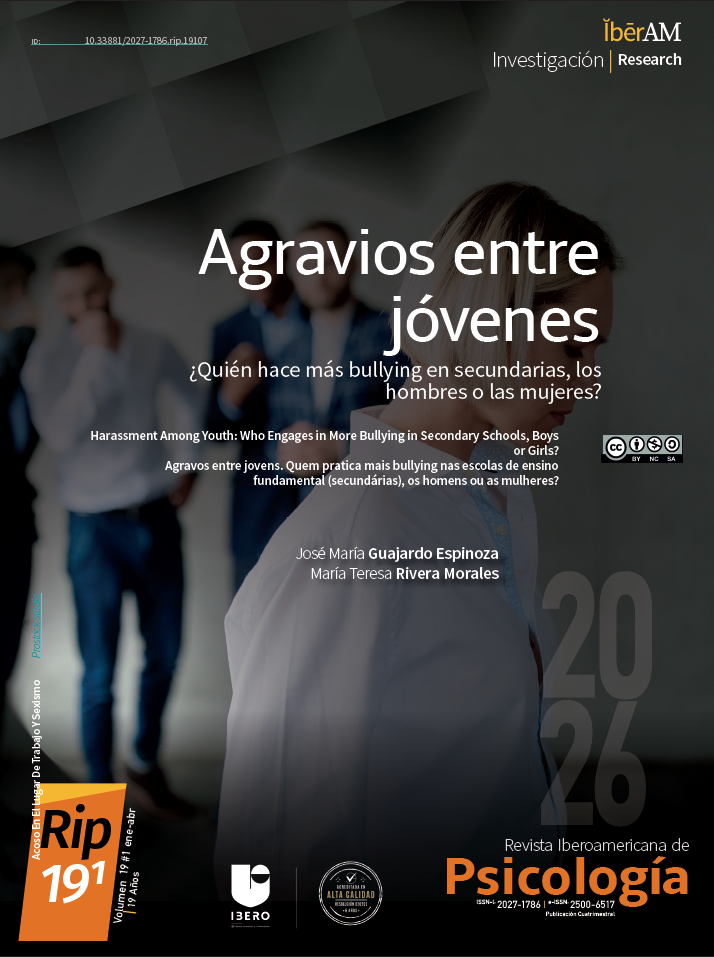
Agravios entre jóvenes. ¿Quién hace más bullying en secundarias, los hombres o las mujeres?
Article Sidebar
 PDF (Español (España))
 FLIP
FLIP

Los autores que publican en la Revista Iberoamericana de Psicología están de acuerdo con los siguientes términos:
- El Autor o los autores, desde que presenta(n) a consideración de esta revista su manuscrito, esta(n) informado(s) acerca de la política de Acceso Abierto, como condición indisociable de publicación, lo que significa que ni él(los), ni la revista han de percibir ingreso alguno por concepto de la lectura de resúmenes o del artículo completo, tampoco por su uso o explotación para generar nuevo conocimiento o para desarrollar aprendizajes alrededor de la obra.
- Los autores conservan los derechos de autor y garantizan a la revista el derecho de ser la primera publicación del trabajo, al igual que licenciado bajo una Creative Commons Atribución-NoComercial-CompartirIgual 4.0 Internacionalque permite que permite a terceros utilizar lo publicado, siempre que se haga mención a la autoría del trabajo y la primera publicación en esta revista, no se utilice con fines comerciales y que las obras que se deriven del artículo se compartan en iguales condiciones.
- Los conceptos y opiniones expresados en los artículos son responsabilidad exclusiva de los autores y no comprometen a la Revista Iberoamericana de Psicología ni a la Corporación Universitaria Iberoamericana. Los contenidos de esta revista se distribuyen bajo licencia de tipo Creative Commons Atribución 4.0 Internacional, la cual exige el debido reconocimiento de las obras y cuyos términos se encuentran en: https://creativecommons.org/licenses/by/4.0/deed.es
- La Revista Iberoamericana de Psicología es una revista de acceso abierto, por lo que tanto el proceso editorial como los contenidos publicados están disponibles para todos los usuarios sin cargo alguno: la Revista no realiza cobro alguno por acceso, lectura o descarga de contenidos ni por procesos o actividades de la editorial con fines de publicación.
Citations



Main Article Content
This study examines the roles of Victim, Perpetrator, and Bystander in school bullying scenarios using a mixed-methods approach that combines frequentist and Bayesian methods. A probabilistic sample of secondary school students was utilized to identify gender differences in each category. Through parametric and non-parametric techniques, the frequentist analysis revealed significant differences in the Victim and Bystander roles, supported by p-values and modest effect sizes, while no significant differences were found in the Perpetrator role. Levene’s test confirmed heterogeneity in variances for the Victim and Bystander categories. From a Bayesian perspective, the Mann-Whitney U test, combined with the Bayes Factor (BF10), provided a more robust evaluation. Bayesian results evidenced strong significant differences in the Victim and Bystander roles, while confirming the null hypothesis in the Perpetrator role, suggesting homogeneity in direct aggression across genders. This approach proved more effective in handling non-normal data and variability, offering consistent conclusions under heterogeneous conditions. The findings highlight a higher frequency of bullying acts targeting females in the Victim role and a more active Bystander role among males, underlining the impact of gender on school bullying dynamics.
Downloads
Article Details
Ato, M., López, J. J., & Benavente, A. (2013). Un sistema de clasificación de
los diseños de investigación en psicología. Anales de Psicología, 29(3),
–1059. https://doi.org/10.6018/analesps.29.3.178511
Barboza, G. E., & Finn, J. D. (2018). Intersections of gender and race in school
bullying: A multilevel perspective. Journal of School Violence, 17(2),
–17.
Beran, T. N., & Rinaldi, C. M. (2020). Cultural differences in bullying
perception and responses. School Psychology International, 41(3),
–241.
Bradshaw, C. P. (2015). Translating research to practice in bullying
prevention. American Psychologist, 70(4), 322–332. https://doi.
org/10.1037/a0039114
Espelage, D. L., & Hong, J. S. (2019). Cyberbullying prevention and
intervention efforts: Current knowledge and future directions.
Canadian Journal of Psychiatry, 64(5), 271–278.
Gaffney, H., Ttofi, M. M., & Farrington, D. P. (2021). What works in anti-bullying
programs? Analysis of effective intervention components. Journal of
School Psychology, 85, 37–56. https://doi.org/10.1016/j.jsp.2020.12.002
García, L. F., & Pérez, E. R. (2020). The role of bystanders in bullying
dynamics: A systematic review. Journal of School Violence, 19(3),
–299. https://doi.org/10.1080/15388220.2020.1727
Gini, G., & Pozzoli, T. (2019). Association between bullying and
psychosomatic problems: A meta-analysis. Pediatrics, 123(3), 1059–
Hymel, S., & Swearer, S. M. (2019). Bullying: An age-old problem. Educational
Psychologist, 54(2), 1–10.
JASP Team. (2023). JASP (Version 0.18.3) [Computer software]. https://jaspstats.
org/
Jiménez-Barbero, J. A., Ruiz-Hernández, J. A., Llor-Zaragoza, L., Pérez-García, M., & Llor-Esteban, B. (2016). Effectiveness of anti-bullying school programs: A meta-analysis. Children and Youth Services
Review, 61, 165–175. https://doi.org/10.1016/j.childyouth.2015.12.015
Kowalski, R. M., & Limber, S. P. (2018). Electronic bullying and its influence on
adolescent health. Journal of Adolescence Health, 57(3), 337–345.
Mejoredu. (2024). Resultados de la encuesta nacional sobre acoso escolar
–2024. Comisión Nacional para la Mejora Continua de la
Educación. https://www.mejoredu.gob.mx
Morales, J. L., & López, E. R. (2021). Promoting empathy in school settings.
School Psychology International, 42(2), 138–159.
Olweus, D., & Limber, S. P. (2019). The Olweus bullying prevention program (OBPP): New evaluations and current status. En P. K. Smith (Ed.), Making an impact on school bullying: Interventions and
recommendations (pp. 23–44). Routledge.
Rivera, M. E., & Hernández, P. S. (2022). Sociocultural influences on bullying
in Mexican schools. Mexican Journal of Educational Research, 27(1),
–61.
Rodríguez Montes, R. (2023). Diagnóstico sobre acoso escolar en una
institución pública del nivel superior. Atena Editora. https://
atenaeditora.com.br/catalogo
Smith, P. K., & Berkkun, F. (2021). Cyberbullying and its impact on young
people. Cyberpsychology Journal, 15(2), 55–75.
Ttofi, M. M., Farrington, D. P., & Lösel, F. (2021). Bullying, long-term effects,
and adult outcomes. Journal of Social Issues, 77(2), 1–22.
UNICEF. (2020). Violencia escolar en América Latina y el Caribe: Superficie
y fondo. https://www.unicef.org/costarica/sites/unicef.org.costarica/
files/2020-02/cr_pub_Violencia_escolar_America_Latina_y_Caribe.pdf
Ybarra, M. L., & Mitchell, K. J. (2021). Social-emotional learning and school
climate change. Prevention Science, 24(1), 45–65.
Zych, I., Ortega-Ruiz, R., & Del Rey, R. (2020). Empathy as a core element of
anti-bullying programs. International Journal of Psychology, 55(3),
–17.