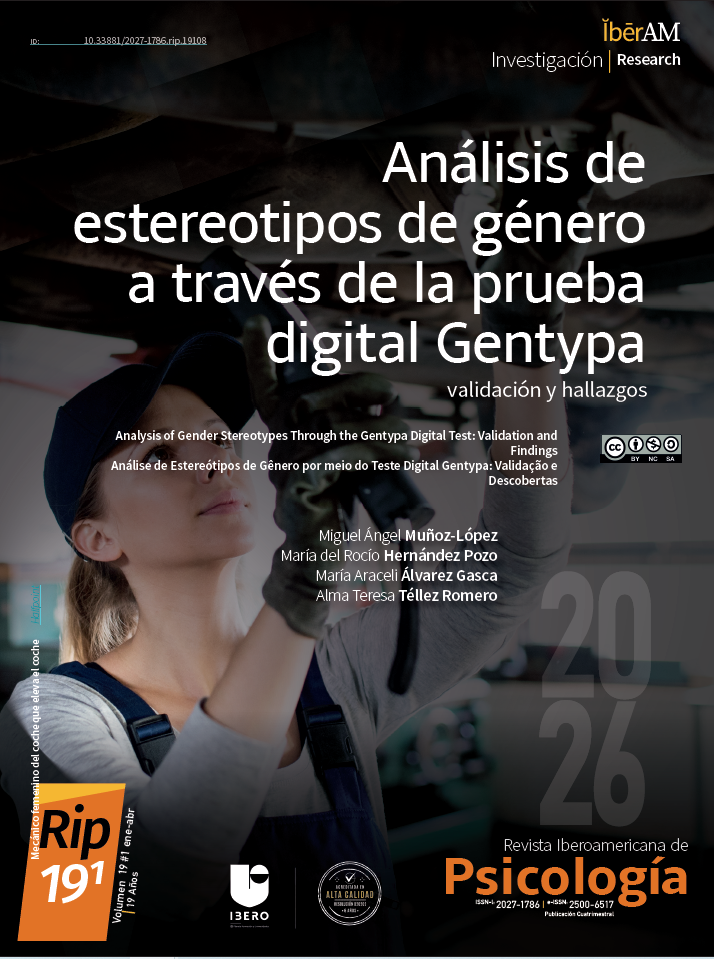
Analysis of Gender Stereotypes Through the Gentypa Digital Test: Validation and Findings
Análisis de estereotipos de género a través de la prueba digital Gentypa: validación y hallazgos
Article Sidebar
 PDF (Español (España))
 FLIP
FLIP

Los autores que publican en la Revista Iberoamericana de Psicología están de acuerdo con los siguientes términos:
- El Autor o los autores, desde que presenta(n) a consideración de esta revista su manuscrito, esta(n) informado(s) acerca de la política de Acceso Abierto, como condición indisociable de publicación, lo que significa que ni él(los), ni la revista han de percibir ingreso alguno por concepto de la lectura de resúmenes o del artículo completo, tampoco por su uso o explotación para generar nuevo conocimiento o para desarrollar aprendizajes alrededor de la obra.
- Los autores conservan los derechos de autor y garantizan a la revista el derecho de ser la primera publicación del trabajo, al igual que licenciado bajo una Creative Commons Atribución-NoComercial-CompartirIgual 4.0 Internacionalque permite que permite a terceros utilizar lo publicado, siempre que se haga mención a la autoría del trabajo y la primera publicación en esta revista, no se utilice con fines comerciales y que las obras que se deriven del artículo se compartan en iguales condiciones.
- Los conceptos y opiniones expresados en los artículos son responsabilidad exclusiva de los autores y no comprometen a la Revista Iberoamericana de Psicología ni a la Corporación Universitaria Iberoamericana. Los contenidos de esta revista se distribuyen bajo licencia de tipo Creative Commons Atribución 4.0 Internacional, la cual exige el debido reconocimiento de las obras y cuyos términos se encuentran en: https://creativecommons.org/licenses/by/4.0/deed.es
- La Revista Iberoamericana de Psicología es una revista de acceso abierto, por lo que tanto el proceso editorial como los contenidos publicados están disponibles para todos los usuarios sin cargo alguno: la Revista no realiza cobro alguno por acceso, lectura o descarga de contenidos ni por procesos o actividades de la editorial con fines de publicación.
Main Article Content

The Gender Stereotype Test (Gentypa) was designed to assess the internalization of beliefs and stereotypes related to gender, employing an indirect approach capable of reducing social desirability bias, associated to the use of questionnaires, especially when addressing sensible topics such as gender stereotypes. The test was implemented via web browsers and could be accessed on various appliances, including computers and mobile devices with internet connectivity. Participants were asked to manipulate human figures (android and gynoid) across 47 trials, guided by characteristics traditionally associated with gender roles. This unique design allowed measuring perceptions of gender by providing either a balanced perspective or one biased toward specific roles. A factor analysis conducted on the results led to the identification of three distinct subscales. Data collected from a diverse sample of 596 participants, aged between 15 and 70 years, revealed that, overall, individuals tend to attribute greater value to traditional feminine and neutral characteristics. Nonetheless, gender and age differences emerged: men scored higher in traits linked to traditional masculinity and neutrality, while women displayed a preference for feminine traits. Additionally, generational differences were identified, with participants under 35 years old exhibiting a more inclusive perception of both masculine and feminine roles. These preliminary findings highlight the potential of the Gentypa test as a valuable tool for implementing educational interventions aimed at challenging stereotypes and promoting gender equity.







Downloads
Publication Facts
Reviewer profiles N/A
Author statements
- Editor & editorial board
- profiles
- Academic society
- Bogotá: Corporación Universitaria Iberoamericana
- Publisher
- Bogotá: Corporación Universitaria Iberoamericana

To learn about these publication facts, click 
PF is maintained by the Public Knowledge Project
Article Details
Ajzen, I. (1991). The theory of planned behavior. Organizational Behavior
and Human Decision Processes, 50(2), 179–211. https://doi.
org/10.1016/0749-5978(91)90020-T
Bem, S. (1974). The measurement of psychological androgyny. Journal of
Consulting and Clinical Psychology, 42(2), 155–162.
Brescoll, V. & Uhlmann, E. (2008). Can an angry woman get ahead? Status
conferral, gender, and expression of emotion in the workplace.
Psychological Science, 19(3), 268–275. https://doi.org/10.1111/j.1467-
2008.02079.x
Connell, R. (2005). Masculinities (2nd ed.). University of California Press.
Diekman, A., & Eagly, A. (2000). Stereotypes as dynamic constructs: Women
and men of the past, present, and future. Personality and Social
Psychology Bulletin, 26(10), 1171–1188.
Eagly, A., & Karau, S. (2002). Role congruity theory of prejudice toward
female leaders. Psychological Review, 109(3), 573–598. https://doi.
org/10.1037/0033-295X.109.3.573
Eagly, A., & Wood, W. (1991). Explaining sex differences in social behavior:
A meta-analytic perspective. Personality and Social Psychology
Bulletin, 17(3), 306–315.
Ellemers, N. (2018). Gender stereotypes. Annual Review of Psychology, 69,
-298. https://doi.org/10.1146/annurev-psych-122216-011719
Gender Study. (Febrero 10, 2024). Key theories on gender roles & social
schemas. Gender Study. https://gender.study/psychology-of-gender/
key-theories-gender-roles-social-schemas/
González-Gijón, G., Alemany-Arrebola, I., Ruiz-Garzón, F. y Ortiz-Gómez, M.
(2024). Los estereotipos de género en adolescentes: análisis en un
contexto multicultural. Revista Colombiana de Educación, (90), 164-
https://doi.org/10.17227/rce.num90-14644
Greenwald, A., Poehlman, T., Uhlmann, E., & Banaji, M. (2009).
Understanding and using the Implicit Association Test: III. Metaanalysis
of predictive validity. Journal of Personality and Social
Psychology, 97(1), 17–41. https://doi.org/10.1037/a0015575
Helgeson, V. S. (1994). Relation of agency and communion to well-being:
Evidence and potential explanations. Psychological Bulletin, 116(3),
–428
Jain, T., Dhar, D., Kapoor, V., Kapur, V., Raj, A. (2022) Measuring gender
attitudes: Developing and testing Implicit Association Tests
for adolescents in India. PLoS ONE 17(6): e0264077. https://doi.
org/10.1371/journal.pone.0264077
Kollmayer, M., Schober, B. & Spiel, C. (2018). Gender Stereotypes in
Education: Development, Consequences, and Interventions.
European Journal of Developmental Psychology, 15(4), 361-377.
https://doi.org/10.1080/17405629.2016.1193483
Project Implicit. (s.f.). Project Implicit: A non-profit organization and
international research collaborative. Project Implicit. https://www.
projectimplicit.net
Ridgeway, C., & Correll, S. (2004). Unpacking the gender system: A
theoretical perspective on gender beliefs and social relations. Gender
& Society, 18(4), 510–531. https://doi.org/10.1177/0891243204265269
Rudman, L., & Glick, P. (2001). Prescriptive gender stereotypes and backlash
toward agentic women. Journal of Social Issues, 57(4), 743–762.
Salgado, J. (2005). Personalidad y deseabilidad social en contextos
organizacionales: implicaciones para la práctica de la psicología del
trabajo y las organizaciones. Papeles del Psicólogo. 26:115-128
Socio Health. (Junio 19 2024). Theoretical perspectives on gender roles
formation. Socio Health. https://socio.health/gender-and-society/
theoretical-perspectives-gender-roles-formation/
Spence, J., Helmreich, R. & Stapp, J. (1974). The Personal Attributes
Questionnaire: A measure of sex-role stereotypes and masculinityfemininity.
JSAS Catalog of Selected Documents in Psychology, 43.
Unity Technologies. (2022). Unity. consultado el 19 de marzo de 2022 en
Wood, W., & Eagly, A. (2010). Gender. In S. T. Fiske, D. T. Gilbert, & G. Lindzey
(Eds.), Handbook of social psychology (5th ed., Vol. 1, pp. 629–667).
Wiley.