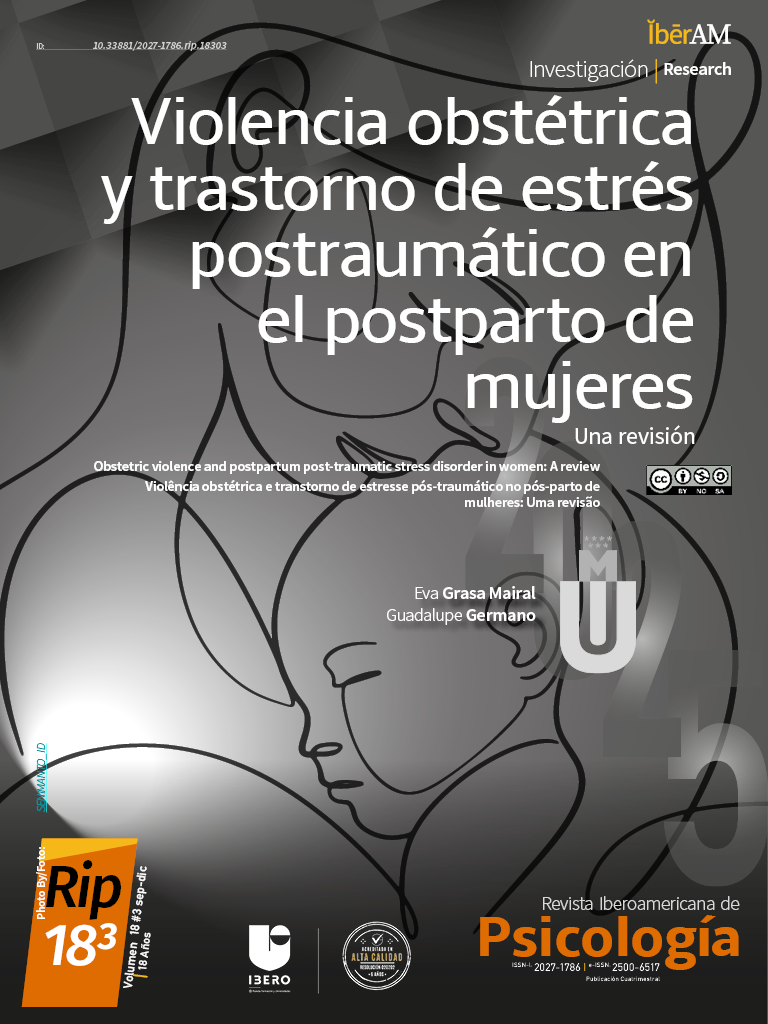
Violência obstétrica e transtorno de estresse pós-traumático no pós-parto de mulheres: uma revisão
Obstetric violence and postpartum post-traumatic stress disorder in women: a review
Barra lateral de artigos
 PDF (Español (España))
 FLIP
FLIP

Los autores que publican en la Revista Iberoamericana de Psicología están de acuerdo con los siguientes términos:
- El Autor o los autores, desde que presenta(n) a consideración de esta revista su manuscrito, esta(n) informado(s) acerca de la política de Acceso Abierto, como condición indisociable de publicación, lo que significa que ni él(los), ni la revista han de percibir ingreso alguno por concepto de la lectura de resúmenes o del artículo completo, tampoco por su uso o explotación para generar nuevo conocimiento o para desarrollar aprendizajes alrededor de la obra.
- Los autores conservan los derechos de autor y garantizan a la revista el derecho de ser la primera publicación del trabajo, al igual que licenciado bajo una Creative Commons Atribución-NoComercial-CompartirIgual 4.0 Internacionalque permite que permite a terceros utilizar lo publicado, siempre que se haga mención a la autoría del trabajo y la primera publicación en esta revista, no se utilice con fines comerciales y que las obras que se deriven del artículo se compartan en iguales condiciones.
- Los conceptos y opiniones expresados en los artículos son responsabilidad exclusiva de los autores y no comprometen a la Revista Iberoamericana de Psicología ni a la Corporación Universitaria Iberoamericana. Los contenidos de esta revista se distribuyen bajo licencia de tipo Creative Commons Atribución 4.0 Internacional, la cual exige el debido reconocimiento de las obras y cuyos términos se encuentran en: https://creativecommons.org/licenses/by/4.0/deed.es
- La Revista Iberoamericana de Psicología es una revista de acceso abierto, por lo que tanto el proceso editorial como los contenidos publicados están disponibles para todos los usuarios sin cargo alguno: la Revista no realiza cobro alguno por acceso, lectura o descarga de contenidos ni por procesos o actividades de la editorial con fines de publicación.
Citações



Conteúdo do artigo principal

A violência obstétrica (VO) é uma forma de violência de gênero exercida durante a gravidez, o parto e/ou o pós-parto. Este estudo foca em analisar o impacto dessa violência na saúde mental das mulheres, especificamente no desenvolvimento do transtorno de estresse pós-traumático (TEPT) pós-parto. Foi realizada uma revisão sistemática seguindo o método PRISMA, selecionando 15 estudos empíricos publicados entre 2019 e 2024. Os resultados confirmaram uma relação entre a VO e o TEPT, evidenciando que a sintomatologia aumenta com o tempo decorrido desde o parto. Foram identificadas como práticas de VO mais prejudiciais o abuso físico e verbal, a falta de consentimento em intervenções, a negligência e a desumanização do processo de parto. A prevalência de TEPT pós-parto varia entre 6% e 20%, sendo maior em mulheres que sofreram VO. Como fatores protetores destacam-se o tratamento respeitoso por parte dos profissionais de saúde, o apoio contínuo de um parceiro, familiar ou doula, e o empoderamento das mulheres durante o parto. Também são benéficas práticas como o contato pele a pele e o início precoce da amamentação. Esses achados ressaltam a necessidade de implementar políticas de atendimento perinatal respeitoso e de capacitar o pessoal de saúde para prevenir a VO e suas consequências. A percepção do processo de parto e do tratamento recebido tem efeitos duradouros na saúde mental materna, afetando o vínculo mãe-bebê e a qualidade de vida a longo prazo.







Downloads
Detalhes do artigo
American Psychiatric Association (2013). Diagnostic and statistical manual of mental disorders. DSM-5™ (5th ed.). American Psychiatric Publishing, Inc. https://doi.org/10.1176/appi.books.9780890425596
Arora, I. H., Woscoboinik, G. G., Mokhtar, S., Quagliarini, B., Bartal, A., Jagodnik, K. M., ... & Dekel, S. (2024). A diagnostic questionnaire for childbirth related posttraumatic stress disorder: A validation study. American Journal of Obstetrics and Gynecology, 231(1), 134-e1. https://doi.org/10.1016/j.ajog.2023.11.1229
Ayers, S., Bond, R., Bertullies, S., & Wijma, K. (2016). The aetiology of post-traumatic stress following childbirth: a meta-analysis and theoretical framework. Psychological medicine, 46(6), 1121–1134. https://doi.org/10.1017/S0033291715002706
Asociación El Parto Es Nuestro. (2016). Informe del Observatorio español de la Violencia Obstétrica. https://www.elpaítoesnuestío.es/sites/default/files/public/OVO/infoímeovo2016.pdf
Barba-Müller, E. (2017). El embarazo conduce cambios duraderos en la estructura del cerebro humano. Psicosomática y Psiquiatría, 1(1), 81-100. https://www.raco.cat/index.php/PsicosomPsiquiatr/article/download/393664/487100
Bohren, MA, Vogel, JP, Hunter, EC, Lutsiv, O, Makh, SK, Souza, JP, et al. (2015). The mistreatment of women during childbirth in health facilities globally: a mixed-methods systematic review. PLoS Med, 12:e1001847. https://doi.org/10.1371/journal.pmed.1001847
Creedy K.D., Sochet M.I. & Horsfall J. (2000) Childbirth and the development of acute trauma symptoms: incidence and contributing factors. Birth, 27(2), 105–111. https://doi.org/10.1046/j.1523-536x.2000.00104.x
Dahlen, H.G., Barclay, L.M., & Homer C.S.E. (2010) The novice birthing: theorising first-time mothers’ experiences of birth at home and in hospital in. Australia Midwifery, 26(1), 53–63. https://doi.org/10.1016/j.midw.2008.01.012
* Dmowska, A., Fielding-Singh, P., Halpern, J., & Prata, N. (2023). The intersection of traumatic childbirth and obstetric racism: A qualitative study. Birth (Berkeley, Calif.), 51(1), 209– 217. https://doi.org/10.1111/birt.12774
Gebremichael, M. W., Worku, A., Medhanyie, A. A., Edin, K., & Berhane, Y. (2018). Women suffer more from disrespectful and abusive care than from the labour pain itself: a qualitative study from Women's perspective. BMC pregnancy and childbirth, 18(1), 392. https://doi.org/10.1186/s12884-018-2026-4
* González-de la Torre, H., González-Artero, P. N., Muñoz de León-Ortega, D., Lancha-de la Cruz, M. R., & Verdú-Soriano, J. (2023). Cultural Adaptation, Validation and Evaluation of the Psychometric Properties of an Obstetric Violence Scale in the Spanish Context. Nursing (Pavia, Italy), 13(4), 1368–1387. https://doi.org/10.3390/nursrep13040115
* Instituto Europeo de Salud Mental Perinatal. (2024). Instituto Europeo de Salud Mental Perinatal| Psicología y Psiquiatría Perinatal. https://saludmentalperinatal.es/
Jha, P., Larsson, M., Christensson, K., & Svanberg, A. S. (2018). Fear of childbirth and depressive symptoms among postnatal women: A cross-sectional survey from Chhattisgarh, India. Women and birth: journal of the Australian College of Midwives, 31(2), e122–e133. https://doi.org/10.1016/j.wombi.2017.07.003
* Jubany-Roig, P., & Guijarro, E. M. (2024). Lactancia materna entre rejas: experiencias de las madres encarceladas en el sistema penitenciario español. Salud Colectiva, 20, e4665. https://doi.org/10.18294/sc.2024.4665
Kendall-Tackett, K. (2014). Birth Trauma: The Causes and Consequences of Childbirth-Related Trauma and PTSD. In: Barnes, D. (eds) Women's Reproductive Mental Health Across the Lifespan. Springer, Cham. https://doi.org/10.1007/978-3-319-05116-1_10
Khsim, I. E. F., Rodríguez, M. M., Riquelme Gallego, B., Caparros-Gonzalez, R. A., & Amezcua-Prieto, C. (2022). Risk Factors for Post-Traumatic Stress Disorder after Childbirth: A Systematic Review. Diagnostics (Basel, Switzerland), 12(11), 2598. https://doi.org/10.3390/diagnostics12112598
* Leavy, E., Cortet, M., Huissoud, C., Desplanches, T., Sormani, J., Viaux-Savelon, S., Dupont, C., Pichon, S., & Gaucher, L. (2023). Disrespect during childbirth and postpartum mental health: a French cohort study. BMC pregnancy and childbirth, 23(1), 241-241. https://doi.org/10.1186/s12884-023-05551-3
* Limmer, C. M., Stoll, K., Vedam, S., Leinweber, J., & Gross, M. M. (2023). Measuring disrespect and abuse during childbirth in a high-resource country: Development and validation of a German self-report tool. Midwifery, 126, 103809. https://doi.org/10.1016/j.midw.2023.103809
* Liu, Y., Zhang, L., Guo, N., & Jiang, H. (2021). Postpartum depression and postpartum post- traumatic stress disorder: prevalence and associated factors. BMC psychiatry, 21(1), 487. https://doi.org/10.1186/s12888-021-03432-7
* Malet, S., Choux, C., Akrich, M., Simon, E., & Sagot, P. (2020). Violence au bloc obstétrical : une enquête prospective multicentrique auprès des femmes dans les maternités de Bourgogne [Mistreatment during childbirth: A prospective multicentric survey among women in maternities in Burgundy]. Gynecologie, obstetrique, fertilite & senologie, 48(11), 790–799. https://doi.org/10.1016/j.gofs.2020.04.012
* Martínez-Vázquez, S., Rodríguez-Almagro, J., Hernández-Martínez, A., Delgado-Rodríguez, M., & Martínez-Galiano, J. M. (2021). Long-Term High Risk of Postpartum Post-Traumatic Stress Disorder (PTSD) and Associated Factors. Journal of clinical medicine, 10(3), 488-488. https://doi.org/10.3390/jcm10030488
* Martínez-Vázquez, S., Rodríguez-Almagro, J., Hernández-Martínez, A., & Martínez-Galiano, J. M. (2021). Factors Associated with Postpartum Post-Traumatic Stress Disorder (PTSD) Following Obstetric Violence: A Cross-Sectional Study. Journal of personalized medicine, 11(5), 338-338. https://doi.org/10.3390/jpm11050338
Mena-Tudela, D., Iglesias-Casás, S., González-Chordá, V. M., Cervera-Gasch, Á., Andreu-Pejó, L., & Valero-Chilleron, M. J. (2020). Obstetric Violence in Spain (Part I): Women's Perception and Interterritorial Differences. International journal of environmental research and public health, 17(21), 7726. https://doi.org/10.3390/ijerph17217726
Moher, D., Liberati, A., Tetzlaff, J., Altman, D. G., y PRISMA Group (2009). Preferred reporting items for systematic reviews and meta-analyses: the PRISMA statement. PLoS medicine, 6(7), e1000097. https://doi.org/10.1371/journal.pmed.1000097
Page, M. J., McKenzie, J. E., Bossuyt, P. M., Boutron, I., Hoffmann, T. C., Mulrow, C. D., Shamseer, L., Tetzlaff, J. M., Akl, E. A., Brennan, S. E., Chou, R., Glanville, J., Grimshaw, J. M., Hróbjartsson, A., Lalu, M. M., Li, T., Loder, E. W., Mayo-Wilson, E., McDonald, S., Alonso-Fernández, S. (2021). Declaración PRISMA 2020: Una guía actualizada para la publicación de revisiones sistemáticas. Revista Española De Cardiología, 74(9), 790-799. https://doi.org/10.1016/j.recesp.2021.06.016
Pérez C, F., & Brahm M, P. (2017). Depresión posparto en padres: ¿por qué también es importante?. Revista chilena de pediatría, 88(5), 582-585. https://dx.doi.org/10.4067/S0370-41062017000500002
Ramírez Matos, E. (2020). Psicología del posparto. Madrid: Editorial Síntesis.
Ramos, E., Acuña González, A. G., García Verduzco, M. F., & Gómez Pérez, C. S. (2023). Violencia obstétrica: una revisión sistemática de literatura. Revista de Ciencias Humanas y Sociales, (100), 60-93. https://doi.org/10.5281/zenodo.7637450
* Rodríguez Coll, P, Casañas, R, Collado Palomares, A, Maldonado Aubian, G, Vicente Garcia, M, & Escuriet Peiro, R. (2020). Proceso de adaptación cultural del “Questionnaire for Assesing the Childbirth Experience (QACE)”. Enfermería Global, 19 (60), 289-321. https://dx.doi.org/10.6018/eglobal.402271
* Sanga, N. E., & Joho, A. A. (2023). Intrapartum violence during facility-based childbirth and its determinants: A cross-sectional study among postnatal women in Tanzania. Women's health (London, England), 19, 17455057231189544. https://doi.org/10.1177/17455057231189544
Sanjuán Suárez, P., & Rueda Laffond, B. (2014). Promoción y prevención de la salud desde la psicología. Editorial Síntesis.
Soet E. J., Brack A.G. & Dilorio C. (2003) Prevalence and predictors of women’s experience of psychological trauma during childbirth. Birth 30(1), 36–46. https://doi.org/10.1046/j.1523-536X.2003.00215.x
* Suarez, A., & Yakupova, V. (2023). Past Traumatic Life Events, Postpartum PTSD, and the Role of Labor Support. International journal of environmental research and public health, 20(11), 6048. https://doi.org/10.3390/ijerph20116048
* Palma Cinquemani M.G. (2023). Impacto de la violencia obstétrica en el desarrollo de estrés postraumático y la calidad del vínculo materno-infantil [Tesis de Máster, Pontificia Universidad Comillas]. Repositorio Institucional Pontificia Universidad Comillas. https://repositorio.comillas.edu/xmlui/handle/11531/74191
Taylor Miller, P. G., Sinclair, M., Gillen, P., McCullough, J. E. M., Miller, P. W., Farrell, D. P., ... & Klaus, P. (2021). Early psychological interventions for prevention and treatment of post-traumatic stress disorder (PTSD) and post-traumatic stress symptoms in post-partum women: A systematic review and meta-analysis. PLoS One, 16(11), e0258170. https://doi.org/10.1371/journal.pone.0258170
Waldenstrom U., Hildingsson I., Rubertsson C. & Radestad I. (2004) A negative birth experience: prevalence and risk factors in a national sample. Birth 31(1), 17–27. https://doi.org/10.1111/j.0730-7659.2004.0270.x
WHO (2019). Recommendations: Intrapartum Care for a Positive Childbirth Experience. https://www.who.int/publications/i/item/9789241550215
Wickham, R. J., & Van Pampus, M. G. (2023). Understanding perinatal mental health psychiatric impact. Frontiers in Psychiatry, 14, 1118492. https://doi.org/10.3389/fpsyt.2023.1118492
Yalley, AA. (2023). “We beat them to help them push”: midwives’ perceptions on obstetric violence in the Ashante and Western regions of Ghana. Women, 3, 22–40. https://doi.org/10.3390/women3010002
* Yakupova, V., Suarez, A., & Kharchenko, A. (2021). Birth Experience, Postpartum PTSD and Depression before and during the Pandemic of COVID-19 in Russia. International journal of environmental research and public health, 19(1), 335-335. https://doi.org/10.3390/ijerph19010335
* Yakupova, V., & Suarez, A. (2022). Postpartum PTSD and birth experience in Russian-speaking women. Midwifery, 112, 103385. https://doi.org/10.1016/j.midw.2022.103385
Yildiz, P. D., Ayers, S., & Phillips, L. (2017). The prevalence of posttraumatic stress disorder in pregnancy and after birth: A systematic review and meta-analysis. Journal of affective disorders, 208, 634–645. https://doi.org/10.1016/j.jad.2016.10.009