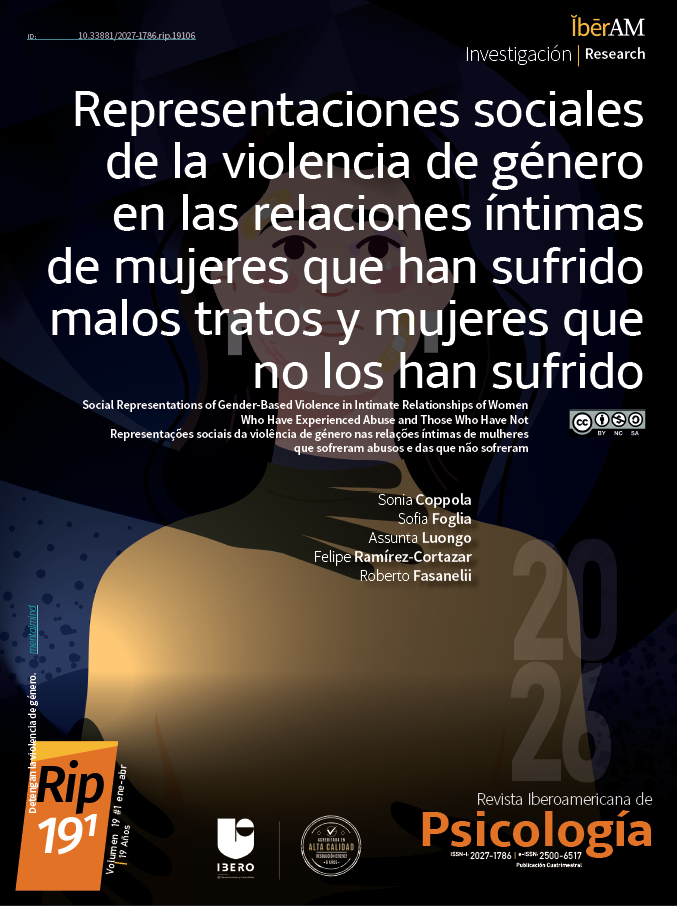
Social Representations of Gender-Based Violence in Intimate Relationships of Women Who Have Experienced Abuse and Those Who Have Not
Representaciones sociales de la violencia de género en las relaciones íntimas de mujeres que han sufrido malos tratos y mujeres que no los han sufrido.
Article Sidebar
 PDF (Español (España))
 FLIP
FLIP

Los autores que publican en la Revista Iberoamericana de Psicología están de acuerdo con los siguientes términos:
- El Autor o los autores, desde que presenta(n) a consideración de esta revista su manuscrito, esta(n) informado(s) acerca de la política de Acceso Abierto, como condición indisociable de publicación, lo que significa que ni él(los), ni la revista han de percibir ingreso alguno por concepto de la lectura de resúmenes o del artículo completo, tampoco por su uso o explotación para generar nuevo conocimiento o para desarrollar aprendizajes alrededor de la obra.
- Los autores conservan los derechos de autor y garantizan a la revista el derecho de ser la primera publicación del trabajo, al igual que licenciado bajo una Creative Commons Atribución-NoComercial-CompartirIgual 4.0 Internacionalque permite que permite a terceros utilizar lo publicado, siempre que se haga mención a la autoría del trabajo y la primera publicación en esta revista, no se utilice con fines comerciales y que las obras que se deriven del artículo se compartan en iguales condiciones.
- Los conceptos y opiniones expresados en los artículos son responsabilidad exclusiva de los autores y no comprometen a la Revista Iberoamericana de Psicología ni a la Corporación Universitaria Iberoamericana. Los contenidos de esta revista se distribuyen bajo licencia de tipo Creative Commons Atribución 4.0 Internacional, la cual exige el debido reconocimiento de las obras y cuyos términos se encuentran en: https://creativecommons.org/licenses/by/4.0/deed.es
- La Revista Iberoamericana de Psicología es una revista de acceso abierto, por lo que tanto el proceso editorial como los contenidos publicados están disponibles para todos los usuarios sin cargo alguno: la Revista no realiza cobro alguno por acceso, lectura o descarga de contenidos ni por procesos o actividades de la editorial con fines de publicación.
Citations



Main Article Content
This study analyzes the social representations of romantic relationships and their link to sexist beliefs, risk factors for gender violence, and attitudes toward violence in two groups of Neapolitan women: university students and women victims of partner violence. Based on Moscovici’s Social Representations Theory (1961), a structural and qualitative-quantitative approach was adopted to examine the representational structure and its relationship with sociocultural sexist beliefs. The methodology included a mixed design with an exploratory scope. A semi-structured questionnaire was used, integrating qualitative techniques such as hierarchical evocation, and psychometric instruments were employed to assess sexism, beliefs in inequality, and violence. A total of 47 women from Campania, Italy, participated, divided into violence victims attending a support center and university students. Data were processed using IRaMuTeQ software, employing similarity analysis and categorical-frequency analysis, along with a correlation analysis of the measured variables made by using SPSS software. The results highlight that respect is the central core of the social representation for victims, related to self-love, unity, and affection. In contrast, students associated romantic relationships with equality and trust. Psychometric scales revealed significant differences between the groups in sexist beliefs and attitudes toward violence. This work contributes to the understanding of the underlying sociocultural dynamics in romantic relationships and their connection to gender violence.
Downloads
Article Details
Abrams, D., Viki, G. T., Masser, B., & Bohner, G. (2003). Perceptions of stranger and acquaintance rape: The role of benevolent and hostile sexism in victim blame and rape proclivity. Journal of Personality and Social Psychology, 84(1), 111-125.
Abric, J.-C. (1994). Les représentations sociales: aspects théoriques. In J.C. Abric (Ed.), Pratiques sociales et représentations(pp.11-36). Paris:PUF.
Abric, J.-C. (2003). La recherche du noyau central et de la zone muette des représentations sociales. In J-C., Abric (Ed.), Méthodes d’étude des représentationes sociales, (pp. 59-80). Ramonville Saint-Agne: Érès.
Amaturo, E., & Punziano, G. (2016). I Mixed Methods nella ricerca sociale. Italia: Carocci editore.
Bardin, L. (1998). L’analyse de contenu. Paris, France: Presses Universitaires de France.
Chay, Z. E., Ling, M. H. T. (2010) COPADS, II: Chi-Square, F-test and t-test Routines from Gopal Kanji's 100 Statistical Tests.
Craig, M. E., Robyak, J., Torosian, E. J. &
Hummer, J. (2006). A study of male veterans' beliefs toward domestic violence in a batterers intervention program. Journal of Interpersonal Violence 21(9), 1111-1128.
De Lemus, S., Castillo, E., Moya Morales, M.C., Padilla Garcìa, J. L. & Ryan, E. (2008). Elaboración y validación del Inventario de Sexismo Ambivalente para adolescents. International Journal of Clinical and Health Psychology, 8(2), 537-562.
Diaz-Aguado Jalón, M. J., Martinez Arias, R. & Martin, G. (2004). Prevenciòn de la violencia y lucha contra la exclusiòn desde la adolescencia. La violencia entre igualesen la escuela y en el ocio. Estudios comparativos e instrumentos de evaluaciòn. Madrid Instituto de la Juventud.
Doise, W. (2011). Sistema e metasistema. Teoria das representações sociais, 50, 123-156.
Duran, M., Moya Morales, M. C., Megias, J. L. & Viki, G. T. (2010). Social perception of rape victims in dating and married relationships: The role of perpetrator’s benevolent sexism, Sex Roles, 62(7), 505-519.
Fasanelli, R., Galli, I., & Piscitelli, A. (2020) Social Representations of Covid-19 in the Framework of Risk Psychology. Papers on social representations. 29(2), 8.1-8.36. [http://psr.iscte-iul.pt/index.php/PSR/index]
Fasanelli, R., Galli, I., Grassia, M.G., Marino, M., Cataldo, R., Lauro, C.N., Castiello, C., Grassia, F., Arcidiacono, C., & Procentese, F. (2020) The Use of Partial Least Squares–Path Modelling to Understand the Impact of Ambivalent Sexism on Violence-Justification among Adolescents. International Journal of Environmental Research and Public Health, 17, 14, 4991. https://doi.org/10.3390/ijerph17144991
Fasanelli, R., Galli, I., & Cañón Rodriguez, M.F. (2021). El reconocimiento como proceso de interacción comunicativa: elementos para una reflexión/Recognition as a process of communicative interaction: elements for a reflection from a public health perspective. Revista de Salud Pública. 23(1), 1-5. https://doi.org/10.15446/rsap.V23n1.72714
Fasanelli, R., Foglia, S., Amalfi, G., & Piscitelli, A. (2024). Team-Building Dimensions Assessment Scale: Development and Psychometric Validation of a New Tool. Insight: the psychological dimensions of society, 12, 401–426. https://doi.org/10.32999/2663-970X/2024-12-11
Flament, C. (1962). L’analyse de similitude. Cahiers du Centre de Recherche Opérationnelle, 4, 63-97.
Forbes, G., Jobe, R., White, K., Bloesch, E. & Adams-Curtis, L. (2005). Perceptions of dating violence following a sexual or nonsexual betrayal of trust: Effects of gender, sexism, acceptance of rape myths, and vengeance motivation. Sex Roles, 52(3-4), 165-173.
Foshee, V. & Langwick, S. (2021). Safe Dates. A Teen Relationship Abuse Prevention Curriculum. Center City: MN. Hazelden Publishing.
Galli, I., Liguori, A., Lorenzi-Cioldi, F., & Fasanelli, R. (2019). Men, Women, and Economic Changes: Social Representations of the Economic Crisis. Interdisciplinaria. 36(2), 283-298. DOI: 10.16888/interd.2019.36.2.18
Galli, I., & Fasanelli, R. (2020) Public Understanding of Science and Common Sense: Social representations of the human microbiome among the expert and non-expert public. Health Psychology Open. 7(1), 1-14. https://doi.org/10.1177/205510292091323
Galli, I., Luongo, A., Ramirez-Cortazàr, F., & Fasanelli, R. (2023). El cruel abrazo del dolor: la endometriosis y sus representaciones. Revista de Psicología, 42(1), 267-304. https://doi.org/10.18800/psico.202401.010
Glick, P. & Fiske, S.T. (1996). The Ambivalent Sexism Inventory: Differentiating hostile and Benevolent sexism. Journal of Personality and Social Psychology, 70(3),491-512.
Glick,P., Sakalli-Ugurlu, N., Ferreira,M. C. & Aguiarde Souza,M.(2002). Ambivalent sexism and attitudes toward wife abuse in Turkey and Brazil. Psychology of Women Quarterly, 26(4), 291-296.
Haj-Yahia, M. & Uysal,A.(2008). Beliefs about wife beating among medical students from Turkey. Journal of Family Violence, 23, 119-133.
Hammond, M. D., Overall, N. C., & Sibley, C. G. (2024). Does powerlessness motivate men and women to endorse sexism? European Journal of Social Psychology, 54, 1354–1363.
Hwang, S.A., Yang B.Z., Fitzgerald, E. F., Bush, B., Cook, K. (2001) Finger printing PCB patterns among Mohawk women. Journal of Exposure Science and Environmental Epidemiology, 11, 184 – 192
Jadhav, B.N., Padma Sri Lekha, P., Abdul Azeez, E.P., Sharma, J., Yadav, A. and Begam J., M. (2024), Impact of gender discrimination on young Indian women’s mental health: do benevolent childhood experiences play any role?, Mental Health and Social Inclusion, . 28 (5), 857-868.
Johnson L, & Stylianou AM. (2022) Coordinated Community Responses to Domestic Violence: A Systematic Review of the Literature. Trauma Violence Abuse. 23(2):506-522. doi: 10.1177/1524838020957984. Epub 2020 Sep 21. PMID: 32954993.
Lee H. (2024) State-level structural sexism and adolescent sexual violence victimization in the US. Child Abuse Negl, 158 (5):107096.
Lichter, E. L., & McCloskey, L. A. (2004). The effects of childhood exposure to marital violence on adolescent gender-role beliefs and dating violence. Psychology of Women Quarterly, 28(4), 344–357.
Markova, I. (2000). Amédée or how to get rid of it: Social representations from a dialogical perspective. Culture & Psychology, 6(4), 419-460.
Meyer, A. D. S., Garcia, A. A. F., Souza, A. P. D., Souza Jr, C. L. D. (2004) Comparison of similarity coefficients used for cluster analysis with dominant markers in maize (Zea Mays L). Genetics and Molecular Biology, 27
Mojahed A, Mack JT, Staudt A, Weise V, Shiva L, Chandra P, et al. (2024) Prevalence and risk factors of intimate partner violence during the COVID-19 pandemic: Results from the population-based study DREAMCORONA. PLoS ONE 19(6): e0306103. https://doi.org/10.1371/journal.pone.0306103
Moscovici, S. (1961). La représentation sociale de la psychanalyse. Bulletin de psychologie, 14(194), 807-810
Moya Morales, M.C. (2004). Actitudes sexistas y nuevas formas de sexismo. In E. Barberá Heredia, I. Mart Martínez Benlloch (Eds.), Psicologia y genero (pp. 271-294). Madrid, Spain: Pearson Educaciòn.
Niolon, P. H., & Centers for Disease Control and Prevention. (2017). Preventing intimate partner violence across the lifespan: A technical package of programs, policies, and practices. Government Printing Office.
Oswald, D. &. (2019). Experiences with Benevolent Sexism: Scale Development and Associations with Women’s Well-Being. Sex Roles. 80. 1-19.
Pozzi, M., Fasanelli, R., Marta, E., Adriano, M., Virgilio, G., Di Taranto A., & Pistoni, C. (2021). Social Representation of Family: A Comparative Study on Italian Young and Older Adults. Journal of Family Issues. 43(3), 752–768. https://doi.org/10.1177/0192513X21994160
Procentese, F., Fasanelli, R., Carnevale, S., Esposito, C., Pisapia, N., Arcidiacono, C., & Di Napoli, I. (2020). Downside: The Perpetrator of Violence in the Representations of Social and Health Professionals. International Journal of Environmental Research and Public Health. https://doi.org/10.3390/ijerph17197061
Rose, M., & Coates, D. (2021). Reducing relationship and sexual violence: Findings from reviews about the effectiveness of respectful relationships and bystander programs in school and tertiary education settings. Australia's National Research Organisation for Women's Safety.
Russel, P. F., Rao, T. R. (1940) On habitat and association of species of anopheline larvae in south-eastern Madras. J. Malaria Inst. India 3: 154-178.
Sakalli-Uğurlu N, Glick P. (2003) Ambivalent sexism and attitudes toward women who engage in premarital sex in Turkey. J Sex Res, 40(3), 296-302.
Sakallı-Uğurlu, N., Yalçın, Z.S. & Glick, P. (2007) Ambivalent Sexism, Belief in a Just World, and Empathy as Predictors of Turkish Students’ Attitudes Toward Rape Victims. Sex Roles 57, 889–895.
Sampaio,D., Oliveira,A., Vinagre,M.G., Gouveia-Pereiras,M., Santos,N. & Ordaz,O.(2000). Representações sociais sobre o suicídio de estudantes do ensino secundário. Análise Psicológica, 2(18), 139 155.
Smyth, C., Cortis, N., Cama, E. Giuntoli, G., Breckenridge, J., & valentine, k. (2020). Evaluation of 1800RESPECT – Final Report. Sydney: Social Policy Research Centre, UNSW Sydney.
Valor-Segura, I., Exposito, F., & Moya Morales, M. C. (2008). Atribuciòn del comportamiento del agresor y consejo a la victima en un caso de violencia domestica. Revista de Psicologia Social, 23(2), 171-180.
Valor-Segura,I., Expósito,F. &MoyaMorales, M.C.(2011). Victim blaming and exoneration of the perpetrator in domestic violence: the role of beliefs in a just world and ambivalent sexism. The Spanish Journal of Psychology, 14(1), 195-206.
Verges, P. (1992). L'évocation de l'argent. Une méthode pourla définition du noyau central d'une représentation. Bulletin de psychologie, 45(405), 203-209.
Vieraitis, L. M., Britto, S., & Kovandzic, T. V. (2007). The Impact of Women’s Status and Gender Inequality on Female Homicide Victimization Rates. Feminist Criminology, 2(1), 57–73.
Viki, G. T., & Abrams, D. (2002). But she was unfaithful: Benevolent sexism and reactions to rape victims who violate traditional gender role expectations. Sex Roles: A Journal of Research, 47, 289–293.
Viki, T., Chiroro, P. & Abrams, D. (2006). Hostile sexism, type ofrape, and self-reported rape proclivity within a sample of Zimbabwean males. Violence Against Women, 12(8), 789-800.
Willis, C. E., Hallinan, M. N. & Melby, J. (1996). Effects of sex role stereotyping among European American student son domestic violence culpability attributions. Sex Roles, 34(7-8),475-491.
Yamawaki, N., Ostenson, J. & Brown C.R. (2009). The functions of gender role traditionalism, ambivalent sexism, injury, and frequency of assault on domestic violence perception. Violence Against Women, 15(9),1126-1142.
Yoshihama,M. (2005).A web in the patriarchal clan system: Tactics of intimate partners in the Japanese sociocultural context. Violence Against Women, 11(10), 1236-1262.